Taking out the trash is hard

August 16, 2013

That title sounds whiny, but I don’t mean it that way. It’s just a fact. When you have chronic pain and chronic fatigue, taking out the trash can be damn hard. I thought about that last night as I returned from taking out the 20130816_173920trash.

Usually it starts when I smell the trash. I have a lousy sense of smell, so if I’m noticing something, then it’s probably already really bad. This is the point when I’d take it out if I was healthy. If I don’t feel up to it, which I usually don’t, then I wait. The next day the trash is smelling a lot worse. I light a scented candle and throw open the windows. I tell myself I’ll take the trash out with me when I go out for something, but of course when I finally go out, I want to save my energy for the outing. So the trash has to wait. Finally the smell is so bad that I force myself to do it.

Getting the trash out of the trash can is tough. I pull at those handles and sometimes I have to stop and rest if the bag gets caught on the can. I carry the trash to my door, put on my shoes, grab my keys, and carry it all the way down the hallway. The trash is usually too heavy and awkward for me to try the stairs, so I wait for the elevator. Once in the basement, I have to lift the trash high to get it into the large bin. Then I take the elevator back upstairs, walk back down the hall, and enter my apartment with a sigh of relief. Putting a clean bag in the bin can wait.

I suppose I could take the trash out more often. That would help, because it would make the trash lighter. But it would also be worse, because it would mean more frequent trips down to the basement. There’s no good answer, of course. When you live alone, you have to take out the trash. I’m just lucky I don’t have to take it outside, especially in bad weather. Still, it’s a long haul down to the basement.

In general I try not to let the little things get to me, but sometimes I get so frustrated at not being able to do small things that other people take for granted. Even worse, people complain about not wanting to do things that I wish I could do! Taking out the trash isn’t glamorous, but it’s a lot better than having a stinking apartment for 3 days. I’m just glad I can still manage to do it, even if it’s really damn hard.


Finding health solutions outside the doctor’s office

August 14, 2013

This month’s blog carnival topic over at Patients for a Moment really caught my attention. It’s being hosted by Getting Closer to Myself – go check it out!

There are a few questions I could have answered, and I’m choosing this one:

How has social media impacted your illness experience?

Anyone who has been following this blog knows that I only recently began to figure out what’s causing my various symptoms. But do you know how I’ve been finding answers? It sure wasn’t at the doctors’ offices! They were all pointing fingers at each other, saying it was someone else’s specialty and not offering me any answers. The real journey started with a book.

I was bored while all of my friends were at work, so I went to the library. I thought I’d check out the books about one of my symptoms because it had been a long time since I’d done that, and while I was perusing the shelves, a title caught my eye about hypothyroid symptoms. I grabbed the book and immediately started reading. That book led to another, and those led to web sites which connected me to Facebook groups. Suddenly I found an entire community of hypothyroid patients online, mostly on Facebook and Twitter and in other places, too. They were dealing with hypothyroid and a lot of the accompanying issues that I also face, like adrenal fatigue.

Being ill can be isolating in the predictable ways: spending days at a time alone at home, not working, and having to miss social events are of course difficult. But the thing that many people don’t realize is that it’s also isolating to be sick and not know why, which symptoms are attributable to which diseases, which symptoms are relevant and which aren’t, or what to do about it all. This can make a person feel very alone, because it seems that no one else understands. Finding books, blogs, web sites, Facebook groups, and Twitter chats of people going through the same thing makes me feel a lot less alone. But they’ve also given me hope because, for the first time in many years, I have treatment routes to explore! In fact, if it wasn’t for the Chronic Babe online support group (which sadly no longer exists) I would have never begun seeing the naturopath who cured my IBS and who has helped me in so many other ways over the past year.

Let’s face it, social media is far from perfect. Finding the right groups and accurate information can feel like looking for a needle in a haystack, but it’s possible. We have to watch out for scams and inaccurate information. There are still doubters. But for me, social media has been incredible. It has given me a community to turn to, answers to my questions, and the hope that I could improve. I can’t wait to see what happens with it next!


When or if I get better?

August 13, 2013

I will never be completely healthy. I accepted that reality a long time ago, and I’m ok with it. Please understand that I’m not happy about it, but I am ok with it. There’s a difference. The thing is, my health took a real dive a couple of years ago, right around the time I started this blog. In hindsight, that’s probably why I started writing it when I did, but at the time I didn’t realize what was beginning; I thought it was just another temporary flare.

So now when I talk about getting “better” I’m not referring to being 100% healthy. I’m just talking about getting back to where I was a few years ago. I’m talking about being well enough to work and date and travel and go out with friends. I’m talking about being able to do laundry and cook and leave the house all in the same day.

For the last two years or so, I’ve been referring to an optimistic future of that sort as “if I get better.” I knew it might not happen. I wasn’t trying to be pessimistic – after all, I was still speaking of it as a possibility. I hadn’t ruled out that it could happen, I just wasn’t so sure. So I said “if” a lot. And then today I caught myself saying, “when I get better…” I immediately stopped and correctly myself to “if” but it had already happened. The “when” was out there, hanging in the air.

I’ve been more optimistic lately. I’ve finally gotten to see two excellent doctors who I’ve been waiting a long time to see. I have several different treatment methods I’ll be starting soon, and any one of them, or possibly all of them, could really help me. I’ve been feeling better for a few weeks, too. The improvement is quite noticeable. Sure, I still can’t do everything I want to do. Yesterday I did laundry, and then had to choose between grocery shopping and seeing friends because I still couldn’t do all three in the same day. (Note: I chose to see friends. Until recently I wouldn’t have made that choice, but I felt well enough to know I could manage to get groceries today, which I did.) This improvement could be temporary or it could be just the beginning of further improvements. I don’t know. I can’t know. But I can hope. And for the first time in a very long time, I do have hope.

So maybe I’ll get better. Maybe I won’t. But the hope is enough to make me switch from thinking about “if” to “when.” And when I get better, boy will I celebrate!


The eny, meeny, miny, moe method of choosing a treatment

August 9, 2013

When a doctor presents multiple treatment options, my favorite question to ask is, “If I were your

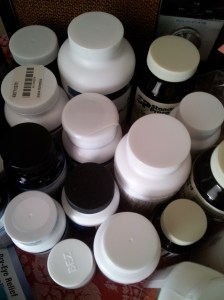
Too many pills!

Too many pills!

sister/daughter/best friend, what would you suggest I do?” This usually makes them stop and think about things in a slightly different way. I preface it by saying that I know it’s ultimately my own decision and I won’t hold them to whatever they say. This has produced some interesting responses over the years.

Right now, though, that isn’t working. Right now I’m choosing among treatments in different specialties, so there’s no one doctor (that I know of) who’s familiar with all of them. I did ask the hematologist this question yesterday, which is how I decided to do iron infusions. But maybe I shouldn’t? Another doctor prescribed hydrocortisone (HC) for my adrenal insufficiency but my naturopath thinks I should keep taking Isocort. That doc isn’t familiar with Isocort. But then, I’ve also received a new thyroid-related prescription, NDT. I can’t do all of these at once, and maybe I shouldn’t do all of them at all!

It’s generally agreed that the thyroid can’t heal until the adrenals are properly supported, so if I’m going to do the HC then I need to do that before the NDT. Some say NDT won’t work if the patient is iron-deficient, so I guess I’d have to do that first. But again, that’s if I do these treatments at all. They all have risks of side effects. What if I do the iron infusions first and have some bad effect and it takes me a long time to recover, and that makes me put off the HC and NDT, which are both promising? Of course, the HC has lots of potential side effects that I’d really rather avoid, too.

It’s overwhelming. This is my body. This is my health. This is my life. I don’t want to fuck around here. It’s too important to just randomly guess. And yet, sometimes I feel like that’s all I’m doing anyway. Right now I’m looking at three new treatments. Those are in addition to my current supplements and my complicated diet. Maybe one or more of them will work. Maybe they’ll make me better. Maybe they’ll make me worse. But I have to try, right? Yes, I have to at least try.