The myth of a miracle cure

July 21, 2013

Warning: This is a bit negative, even for me, so make sure you’re feeling positive and upbeat before you read it. And afterwards, go look at pictures of cute puppies or something. A picture of my favorite cutie is here, just for some balance.Pooch

I just read a book where a little boy has a fatal, degenerative disease. It was fiction, and the disease was made up, so I knew, based on the type of book, that the disease would be cured just before it killed him. And of course, it was.

My health problems are not fatal, but they’re degenerative. And there’s no miracle cure about to come fix me. The problem is, I don’t think most people understand that.

In books and movies, tv shows and plays, it so often happens that a miracle cure comes along just in time. Some researcher has a great idea, loved ones waive all liability, the cure is administered, and everyone lives happily ever after. It happens practically over night. In fact, not only does the disease stop getting worse, but they even manage to improve the person’s health, as in the novel I just read, so that they get to be completely healthy. If only, right?

After so much exposure of this sort, people start to think that this is how it works in the real world. Those of us who actually have these diseases know better, though. We follow all the research on our disease. We know who’s working on it and who isn’t. We know how much money is being spent on our disease versus others. We know if the focus is on cures or on treatments or maybe, if we’re really lucky, on both. We know if any work is being done on preventative measures or on diagnostic techniques. Some of us follow the research in great detail and others only have a vague awareness, but we all know. We know, on some level, if a promising cure or treatment is in the works or if it’s something we’ll be lucky to see 40 years from now.

We also know that even if a cure or treatment is close, that doesn’t mean it’s accessible to us. If a cure was found today, how long would it take to reach its intended target? Well, the answer varies based on so many factors, but the answer is always measured in years, not in days like in the movies. Even if you manage to get into a human trial of the treatment, and even if you manage to get the drug instead of a placebo, human trials don’t happen over night. There are so many stages that come first, including animal trials. FDA approval is needed in the U.S. And there are great risks to taking an untested drug. You know how sometimes you take a drug knowing there’s a slight chance, or even a great chance, of a certain side effect? Well who do you think gets those side effects first? Yep, the testers. It’s definitely risky.

And sometimes it’s difficult or even impossible to get into those trials. If you have to wait for the drug to come to market, it can take so much longer. But wait, don’t forget the costs! The pharmaceutical companies just spent a whole lot of money developing whatever you’re about to take and they want to get some of that money back. In the books and movies you just get the drug. There’s insurance or a rich uncle or some compassionate benefactor. Too bad it isn’t always like that in the real world. If you don’t happen to have insurance to cover the drug (and it often doesn’t cover the new ones) and if you don’t have the money to pay for it (which could easily be tens of thousands of dollars – no that isn’t an exaggeration) then you’re just out of luck. Sorry. Too bad. Go home.

So the next time someone says, “Isn’t there a pill you can take?” send them over here. Maybe this will open their eyes just a bit. There isn’t a cure, or even a treatment, for every illness. Oh, how I wish there were. Some are getting closer, but people need to trust us when we tell them if there’s a treatment coming or not. We’re paying attention. We know these things. We’re not about to be surprised over night. If and when a treatment comes along, we’ll know about it long before we’re able to take it, and we’ll be counting down the years.


Don’t punt me

July 10, 2013

The best thing a doctor can say to me is, “I don’t know.” Well, ok, that’s a lie. The best thing is, “Here’s a cure.” But if they don’t know the answer, then the best thing is, “I don’t know.” As soon as a doctor says that, I know I want to keep seeing them.

The problem is, too many won’t admit when they don’t know the answer. Of course, this isn’t a problem that’s unique to the medical profession. I know plenty of people who do this in their jobs and outside of their jobs, because they think that there’s something wrong with admitting they don’t know absolutely everything about a topic. I’ve had a lot of problems because of that kind of attitude in the past, so now I know to watch for it and avoid it.

Last week I mentioned that my finger was swollen and painful and that I was happy to ignore it. Well, after a few days it got numb and changed colors, so I thought maybe I should get it checked out. My primary care physician (PCP) wasn’t in, so I saw a physician’s assistant (PA) in her office. The PA said it was infected and prescribed antibiotics. She didn’t seem completely confident, but it did make sense. She told me to come back if it wasn’t much better in 48 hours. Three days later I saw her again. The discoloration was worse and the skin had hardened. She said that she thought it was healing, but clearly she wasn’t sure. She got a nurse practitioner and the NP told me that she thought it was getting better, and if it didn’t get better by the time I finished my antibiotics in 4 more days, then I should let her know and they would send me to a “hand doctor.” Yes, she actually said “hand doctor” to me! I didn’t like her lack of confidence, and when I mentioned that I was seeing my rheumatologist this week, she was clearly relieved. She exhaled and said that I should definitely have my rheum take a look.

She punted me.

She didn’t know what was going on, but instead of saying it, she told me to wait and see what happened, then to go to someone else if it didn’t heal. What kind of attitude is that?!? (And yes, I plan to leave this office after I get some insurance issues worked out – clearly they are not the right ones for me.) If she had told me she wasn’t sure what was happening, I would have respected her honesty. Instead, I found myself distrustful of both the PA and the NP, and nervous about what was happening with my finger.

I did see my rheum. She didn’t know what was happening, but she was honest about it. She felt that it was an infection that was healing, but the spread of the discoloration made her wonder if there was an infection under the nail. She said that she didn’t have the tools to check that, and it wasn’t her field anyway, so she wanted me to see my dermatologist. She asked who I saw, and was pleased that it’s someone she considers to be very good. I asked her if I should wait until I finish the antibiotics to see what happens and she said no, that I should be seen as soon as possible. Now THAT’S how you handle an uncertainty! She told me what she thought was going on, admitted that she wasn’t sure, told me which specialist to see, and insisted I address it immediately. BINGO! There are many reasons I love my rheum, and that’s a big one.

I’m going to see the dermatologist later today. I have seen many people in that office and liked them all. I am seeing a PA today who I have never seen before, because she was the only one with a last-minute opening. Still, I trust that they will treat me right, as they have before. And I refuse to be punted again. I want answers or recommendations, and I won’t accept anything else.


The trouble with sleeping late

June 29, 2013

I had another bout of annoying insomnia last night. This just started in the past year and it’s baffling. I wake up around 4am for no reason that I can figure out, then I just stay awake for a couple of hours before getting back to sleep. Then I wake up around the normal time, just deprived of sleep. It makes no sense to me.

Last night was different, though. After 2.5 hours of lying there awake, I finally drifted back off to sleep. But instead of waking up around 9 or 10 am, I slept until 10:42! I would have probably gone back to sleep, but seeing those numbers on the clock forced me to wake up. My pill schedule was all messed up! And of course it’s a Saturday, so I couldn’t ask my naturopath for advice.

First things first, I took my thyroid pill. That always happens as soon as I wake up. But then, 1/2 hour later, should I take my regular dose of Isocort? It’s an adrenal supplement, and the whole point is to take it at certain times of day based on my adrenal function at those times. My cortisol is low in the mornings, so I usually take it when I wake up (1/2 hour after the thyroid pill to avoid conflicts.) But should I take it at 11:15? That was too late! I compromised and took a half dose. I didn’t think it would be a good idea to skip it completely.

I had to wait a bit longer to eat, so breakfast was going to be around 11:30. Maybe I should just make that lunch. But wait, I have pills that I have to take with food 3 times a day! Ok, so I had a really small breakfast and took my breakfast pills, and I’ll have lunch around 2pm.

But wait! Lunch at 2pm means I can’t take my next round of adrenal supplements until 3pm and that’s too late! I’m supposed to take them around 2pm, but I have to wait an hour after eating before I take them. So ok, maybe I’ll move lunch to 1:30 and take the pills at 2:30. That’s not too bad.

And the fiber I’m supposed to take 2 hours after the breakfast pills and at least 1/2 hour before the lunch pills? Well, too bad. I’ll just have to take it closer to the other pills and so be it.

Before all the pills, if I slept late that just meant I started my day late. When did it become so damn complicated?


Taking pills 10 times a day, literally

May 17, 2013

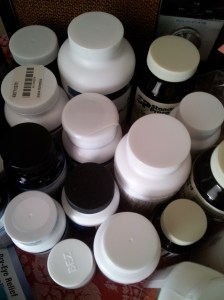
I wrote once about how much time I spend on health stuff. I wrote about lawyers and insurance and doctors… those are the things that you’d expect to be both time consuming and mentally consuming. As I was trying to work out a new pill schedule the other day, it occurred to me that most people probably have no idea just how time consuming, not to mention mentally consuming, it can be to take pills!

A “healthy” person might not take any pills. Or they swallow an occasional multivitamin or birth control pill. I’ve been trying to remember when I last had a day without pills and my guess is that it was probably around 1996 or so. Then for years my pills were simple: a birth control pill, then a BCP and a thyroid pill, then a BCP and the thyroid one and a multivitamin…. and then it got worse.

I miss the days of simply taking a pill or two with meals. Now, everything has to be timed out so carefully. There are the pills that must be taken with food. There are the pills that must be taken away from food. There are pills that must be taken away from each other. There are pills that need to be taken at specific times of day.

Oh, and when I say “pills,” that includes liquid meds as well.

It’s taken a lot of mental energy and help from my naturopath, but I finally have a working schedule (until the next addition or subtraction, that is):

  • 8am: thyroid pill – 1 pill
  • 8:30: adrenal support, dhea – 5 pills
  • after breakfast: a whole bunch – 9 pills and 8 sets of drops, and a cream
  • 2 hours after breakfast: fiber – 2 pills
  • after lunch: another bunch – 5 pills and 7 sets of drops
  • 2pm: adrenal support, dhea, calcium – 4 pills
  • 4pm: fiber – 2 pills
  • before dinner: calcium – 1 pill
  • after dinner: another bunch – 7 pills and 8 sets of drops
  • 9pm: bedtime stuff – 4 pills

Wow, this looks even worse written out than it did in my head. Actually, the original title for this post had “9 times a day” written, because that’s how I’d counted it. Then as I wrote it out, I realized I’d missed one. It’s a lot to keep track of. The thyroid pill has to be an hour before meals. The adrenal support has to be 15 minutes before eating and at specific times of day. The fiber has to be 2 hours after and 1/2 hour before eating. Some of the mealtime pills are taken then because they have to be taken with food. The multivitamin has extra iron, and the iron and calcium have to be taken at least 1/2 hour apart. In fact, I should be taking calcium 3 times per day but I’m only taking it 2 times per day because I can’t figure out where else to squeeze it in! The drops don’t have to be taken at specific times, but they’re hard to carry around, so I need to take them at home. That means that sometimes I only take them 2 times per day, but that’s ok, as long as I at least take the drops for vitamin D. Some of the pills, though, can’t be missed. Like, they really, seriously, can’t be missed. Like, if it’s really late and I don’t want to deal with driving and so my parents say I can just stay the night, I can’t. Because I have to get home. I have to get home to where the pills are. Because I really can’t skip those morning pills, or even take them late. Some don’t seem too important, but they are. I tried cutting the fiber back to 2 times per day instead of 3 and the effects were horrendous. I’m not about to try that again any time soon!

So you may be wondering what my point is? I have three points:

  1. For those who are in a similar situation, you’re not alone. I get it. Lots of us get it.
  2. For those who complain when they have to take a single pill for a cold, or even for something daily, tell it to someone else. I don’t want to listen.
  3. If you think that by not working I just sit around all day and have fun, and you haven’t figured out yet that that’s not how it works, just imagine trying to keep track of all of this. Imagine how long it takes me to fill my pill boxes each week. And since the drops can’t be prepared in batch in advance, I have to deal with those three times, every single day. Trust me, it would be easier to work a job.

And on that note, I’m off to get some sleep. I hope. Because there’s no more sleeping in for me – I have to be up early to take those pills!