Feeling too sick to remember how to feel better

May 30, 2014

If I get a cold, I know what to do. I know to drink decaf tea. I know to eat certain foods. I know which medications to take and when and why. But the second I have a fever, all that good knowledge gets lost somewhere in my brain and I forget what I’m supposed to do. When I talk to a friend or my mom, though, they remind me. Too bad they don’t know what to suggest for my extreme fatigue.

Even in my lousy state, I knew it started with all of the extra activity on Saturday. I did a lot that day, moving and being alert almost nonstop from 7am to 3pm, and I assumed that was the cause. Or maybe I ate something I shouldn’t have when I went out to lunch on Saturday. I was careful, but you never know. In the haze, I knew I shouldn’t push myself. I watched a lot of tv, read, watched movies, read, watched more tv, and read some more. I left the house for groceries and for a medical appointment, and felt much worse after each outing. It bothered me so much that no one knew why this was happening.

Except someone did. I did. Or I would have, if only I could have thought clearly. I knew I wasn’t thinking clearly. I knew there was a metaphorical strip of gauze over my brain, obscuring the information inside. Thank goodness I was able to peak under the gauze for just a moment last night. That changed everything.

Last night it occurred to me that I could take an Isocort tablet. Isocort is a supplement that can be used to help treat less severe adrenal insufficiency. At one point I was taking 5 tablets. When I eventually weaned off of it, my naturopath told me to take it occasionally as needed (and we discussed what “as needed” meant.) Thankfully, I had a fair amount left, since it’s since been discontinued. I almost never take it, but last night it occurred to me that I should. However, even in my poor cognitive state, I knew better than to take it at night. Thankfully, I knew enough to take it out and leave it with my other pills where I wouldn’t miss it.

This morning I wanted to try getting by without the Isocort. Ah, what a state I was in to think that could happen. I finally took one tablet around 1pm, knowing I still had time to take more in the afternoon if I needed to. I didn’t need to. By 3pm I was feeling much better, and at 3:30 I went out for a short walk. It felt so good!

More than the physical improvement was the cognitive improvement. The gauze lifted, and it all made sense. I should have taken Isocort preventatively on Saturday. I’ll do that the next time I’m in a similar situation. I overdid things on Saturday and that caused my adrenal gland to go on vacation for a bit. While it was lying on a beach in Malibu, I was suffering. Taking an Isocort or two on Sunday would have helped me to recover more quickly. Resting so much was the right thing to do, but I needed to support my adrenal glands also. Without that support, they weren’t about to return from their peaceful vacation away from my overwrought body. And of course, each extra bit of activity, each outing, only made me feel worse as my adrenals retreated even further.

Today is Friday. It took four days for me to realize that Saturday’s activities were the trigger to my recent downturn. It took another day to realize what I should do about it. And it wasn’t until I felt better that I figured out what really happened. So the question is, what do I do differently next time? Obviously I should take preventative measures, but usually I don’t know I’ll need to. By the time I would figure it out, I’m no longer thinking clearly enough to do it. I can write down a list of things to do the next time I feel fatigued, but that only works if I remember to look at the list. I don’t think I can trust myself, so I’ll do the only other thing I can think of: I’ll tell my parents and a few close friends what to suggest the next time I tell them I’m fatigued. With any luck, at least one of them will suggest the right thing and I’ll take that advice. But if I don’t, and if I write again about a downturn involving fatigue, I hope one of you will point me back to this post!


Looking for the pieces of my health puzzle

May 25, 2014

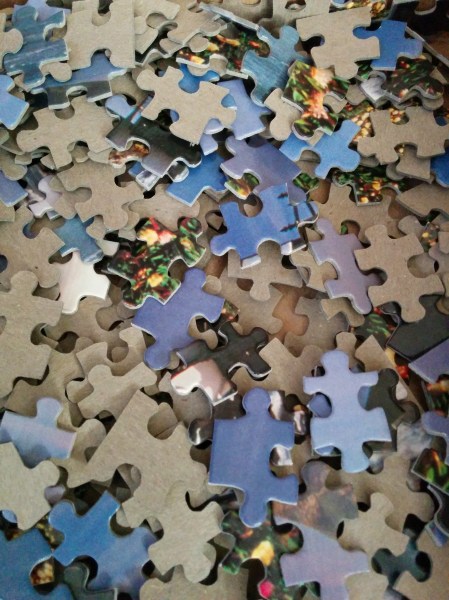
I have great memories of summer vacations in Maine with my family. As a teenager and into adulthood, we shared many wonderful times up there. When the weather was nice, we were constantly outdoors. When it rained, we sat around the dining room table working on jigsaw puzzles. We put together beautiful pictures of ocean views, warm sunsets, and peaceful gardens. Unfortunately, sometimes we reached the end and found that one or more of the pieces were missing. It was frustrating and disappointing to be so close and have no hope of finishing the puzzle.

My health is something like those unfinished puzzles. The difference is, I haven’t given up searching under the furniture and in drawers for the missing pieces yet.

The pieces I’ve found

It’s been a long search for all of those puzzle pieces. We all know some of them: eat healthy, exercise, get lots of sleep. But I’d done all of that and was still so sick. So I did some research and tried new things. Here are the big ones:

  • I went gluten-free.
  • I found a new doctor to treat my thyroid.
  • I changed my thyroid medication.
  • I found a naturopath and began seeing her regularly.
  • I discovered and treated my adrenal insufficiency.
  • I discovered new food intolerances and avoided those foods entirely. My leaky gut healed.
  • I added vitamins and minerals to my pill regimen.
  • I added other supplements as recommended by my naturopath.
  • I began using medical marijuana occasionally.
  • I found a better dose of melatonin and used that regularly.
  • I was diagnosed with a form of sleep apnea and began using a CPAP machine.

I’m sure there are more pieces that I’ve forgotten, but I think these are the big ones. This list sounds straightforward, but it isn’t. It has taken me two and a half years to do all of this. I did the research myself. Except for some of the supplements from my naturopath, every step is one that I researched myself. This was not easy, and at times I felt like giving up, but as I found each piece, I felt slightly better, and that encouraged me to keep searching for more pieces.

The pieces I hope to find

I can’t believe how much better I am feeling now compared to two and a half years ago! There were times when I thought I’d never feel this good again. Still, I’m by no means where I want to be, and I can’t do much more with the pieces I’ve already found. I know I have more pieces still to find.

To be honest, I’m running out of ideas. I have tried almost everything that has been suggested by the books, the websites, and other patients in patient forums. I can feel that at least one piece of the puzzle is still missing. Maybe I’m missing a dozen pieces. There’s no way to know until I try something new. Right now I’m considering doing a genetic test through 23andme. If you’ve done this, I’d love to know what you think of it, either positive or negative, in the comments. I would be looking specifically for a mutation on the MTHFR gene, but of course I would be open to any other useful information I could glean from the test.

Beyond that, I’m feeling stuck. Maybe I’ll try the AIP diet again. Maybe I’ll try a Paleo diet. Maybe I’ll come across something else in my reading. No matter what, I know I’ll keep looking.

My puzzle

We each have our own puzzles. For many of us, the pieces are damaged and will never properly fit together again. I know that will be the case for me. I’m looking for the missing pieces of my puzzle, but I’m under no illusions about the best possible outcome I could achieve. I will always have symptoms. I am just hoping to lessen them.

Your puzzle

I don’t know what your puzzle is. Maybe you’ve found all of your pieces and have fixed them the best that you can. Maybe you’re working on fixing the damaged pieces. Or maybe, like me, you’re still searching for your missing pieces. Whatever the case, I wish you the best of luck to get the best version of your puzzle that you can.


A few questions for certain politicians

May 21, 2014

It’s tough when the national budget doesn’t balance. I get that. But what what are citizens supposed to do when they have no hope of balancing their personal budgets because they are too sick or disabled to work?

We pay into Social Security so that it will be there when we need it. Then we become disabled and need it, and too many of us are denied it. I’m not even going to talk about the fact that the payment is too small to even pay a modest rent in many parts of this country. I’m just talking about how hard it is to get this so-called “safety net” when we need it. And yet certain politicians still suggest that we need to cut back on the program. So here’s my question for them:

Without social security, or with reduced payments, how are we supposed to pay for basic things like rent, food, and health care?*

I’ve heard one common answer many times: your church will take care of you. Um, no. What if you’re not Christian? What if you’re not religious? What if you just moved to a new community and don’t have a church community yet? What if there’s no church or other religious establishment nearby?

Now, let’s suppose none of those issues apply in your care. Let’s say your church and its members want to help, but they don’t have enough money. Are they expected to pay all of your bills for the rest of your life (or until you turn 65 and standard Social Security supposedly starts?) Could they really afford to pay the housing, food, and medical bills for all of its members in need of that financial help? So here’s another question for those politicians:

Are the only people “worthy” of living in this country those who are able to work, those who marry people who can work, those who inherit large amounts of money, and those who win the lottery?

I greatly resent having to prove that I’m too sick to work. But what I resent even more is going through this process while healthy people on tv suggest that the government needs to cut back on these payments. I’m sure that seems like a perfectly reasonable approach for all of these well-paid people who assume they will be able to work for as long as they want and so others should too. But that’s the tricky thing about disabling conditions: most of them are not predictable years in advance. Just because someone is working now, doesn’t mean they will be able to work 10 years, or even 10 months, from now. Maybe they will and maybe they won’t. And if they can’t? Will they change their mind about the policy? What if it doesn’t happen to them? What if it happens to a friend? Will they pay their friend’s bills, or will they say that it’s not their responsibility? Will they tell their friend to find a church to help out? Or will they realize how insensitive and callous it sounds to suggest that their friend shouldn’t have access to the government system they paid into that’s designed specifically to support people in this particular situation? This begs the question:

Should everyone be treated equally? Or do you suggest different treatment for already-wealthy individuals?

It’s easy to suggest that disabled people are lazy and choosing not to work. It’s always easy to use a stereotype to justify your own prejudice. It’s also easy to say that all Jews are cheap, all bisexuals are promiscuous, all black teenagers are in gangs, and all women are overly emotional. It’s easy, but that doesn’t make it true. These stereotypes might be true for some people, but they are not true for all people. Just as some people on SSDI are lazy and choosing not to work, but that is not true for everyone.

And that’s why, most of all, I resent being stereotyped as a justification for rich politicians looking to score political points and get even richer. That’s why, most of all, I have to ask:

How can you live with yourself?

*Yes, there is Medicare and Medicaid and The Affordable Care Act (Obamacare,) but those are not available to everyone and they do not cover all costs. I wish they did, but they don’t. I have great health insurance, one of the best plans available. Last month, in addition to my premium, I spent $600 on over-the-counter medications, copays, parking at medical offices, visits with my naturopath (who has been more helpful than the doctors who are covered by insurance,) and other things. Other months have included items such as orthodics that are necessary to me but are not covered by insurance. Of course, this does not include the so-called extras, like gas to get to appointments or paying for help with things I can’t do like cleaning and shoveling show.


When even birthdays are overwhelming

May 16, 2014

The thing about being single is that I don’t have automatic birthday plans. When I’ve been dating someone, we’d plan a day together. Sometimes I went out with friends, but I always had that default date. But when I’m single, nothing happens for my birthday unless I plan it. Well, a couple years ago friends threw me a surprise party. But most years nothing happens unless I plan it.

I remember one year I gathered a bunch of friends from different social circles and arranged for us all to meet downtown for dim sum in Chinatown, and then to hang out for a while afterwards. That was a nice birthday. I would never plan something so high-energy now. Two years in a row I got friends together for dinners out. These days I’m not so fond of going out at night.

I thought about skipping by birthday this year. After all, I skipped New Year’s Eve, so why not skip my birthday? To be honest, I might have skipped it if it was on a weekday. With all of my friends at work, it would have been the perfect excuse. But with my birthday on a Sunday, it just seemed too depressing. I should really do something, right?

A friend is going to be visiting from out of town. I thought about doing something with just the two of us, but she has to head back home early in the day. I thought about inviting one or two other friends. And then I figured, what the hell, I’ll have a freaking party. Ok, birthday gods, you win!

Of course, I’m not up to anything high-energy. The party was going to be a bbq at my parents’ house while they’re away, but that felt like way too much effort. I wouldn’t have the energy to get the food and be the hostess and celebrate. It was overwhelming just to think about it.

So I downgraded it. Now it’s going to be an afternoon thing. We’ll just hang out. If the weather is nice, people can throw around a frisbee in the yard. If the weather is lousy (or just too warm for me) then we’ll hang out in the house and play board games, which I really love. Food will be simple and easy to prepare in advance: chips and salsa, cheese and crackers. My mother wants me to have a gluten-free cake, but I told her I don’t care about having a cake. The truth is, I’m already overwhelmed at the idea of hosting and celebrating at the same time. Picking up a cake that morning would just be too damn much. And I really don’t care enough to go to all that trouble.

I have a plan. A plan is good. It’s a start. Now I just hope I feel well enough to go through with it that day, and that’s impossible to predict.