What do I do all day without a “job”?

September 7, 2013

I have been asked over and over again what I do with my days since I don’t “work.” I understand where they’re coming from. I guess I used to wonder the same kinds of things. Now I realize how absurd that is.

First of all, I do work. I have a job: my health. I don’t get paid for it, but it’s my job. And it’s harder than any paid work I’ve ever done.

Several years ago I quit a job where I was unhappy. Suddenly I had so much free time! I learned new skills, Atlanticimproved my diet, got into a good exercise routine, went out many nights with friends, spent more time with family, traveled… it was a great time and I hated to go back to work. The thing is, I felt good then.

It’s not like that now. Now, I can’t do half of what I did then in a day. Now, I have to rest a whole lot more. I spend more time in bed. I read more. I want to go out but can’t. I spend huge amounts of time planning out my meals, pills, and other health-related stuff. And that’s before we talk about the paperwork.

Right now I’m hiding from the work. I’m writing here because the rest is too overwhelming. I should really be doing one of these (though some can only be done on weekdays):

  • Reading one of the five library books I have out on hypothyroidism.
  • Filling out one of the two forms that the long term disability insurance company sent me.
  • Contacting my lawyer about the next steps in the long term disability insurance application.
  • Trying again to fix a dental insurance status issue.
  • Figuring out if a medical appointment I had last month will be covered by my current or my old health insurance.
  • Filling a prescription.
  • Making an appointment with a new primary care physician (pcp).
  • Changing my health insurance over to a new pcp.
  • Making an appointment with a resident in the new pcp’s office so that I can get referrals for specialists with whom I already have appointments, since I’ll need the referrals before I’m able to see the pcp.
  • Entering recent lab results into my tracking spreadsheet.
  • Creating a new tracking spreadsheet for daily symptoms.

Of course, in addition to paperwork, I also spend a lot of time and energy around food. I have to figure out what to eat that fits in my diet, 20120917_181648what I’m able to prepare given the weather (I can’t use the oven all summer and I can’t use the stove on the really hot days,) and how to time my meals. Today I’m supposed to have lunch with my parents, but they want to eat around 1:30. That would mean I wouldn’t take my lunch pills until 2, and then I’d need to wait an hour before I could take my 2pm pills, so they’d have to wait until 3pm. That’s no good. So I have to eat earlier on my own. And of course, that doesn’t even include the time spent taking pills. Then there’s the 20-30 minutes I spend each week preparing my pills by filling my weekly pill boxes. Buying the pills also takes time, but that feels like a whole different level.

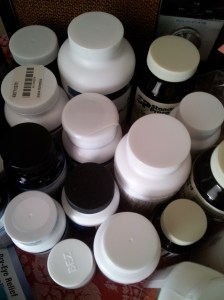
There’s always more reading and research to be done. I follow patient groups online, a few useful blogs, twitter, and I also read books from the library.

Up to now I’ve been talking about the health-related work. There’s still the everyday work. Cooking, dishes, and laundry exist in my world just like they exist in a “healthy” person’s world, but they take a lot more energy for me. Doing laundry and going grocery shopping in the same day means I can’t do anything else that takes much energy, and some days I can’t even do that much. Going out with friends means I have to rest the next day. For me, “rest” usually means not leaving my apartment. I stay home and read a lot. I watch some tv. I check Facebook. But I don’t go out or do anything strenuous at home.

And by the way, don’t forget that I spend 10-11 hours in bed each night. I figure this isn’t too bad, since I know people with similar conditions often spend many more hours in bed. Still, when you compare this to others my age who only spend 7-8 hours in bed each night, you can see that I lose 2-4 hours of “productive” time each day. I also need to rest after each meal. I’ve learned that if I eat and then immediately try to do something heroic, like put the dishes in the sink, I feel really horrible. Instead, I sit for at least half an hour after each meal. I use that time to watch tv and knit. It’s not exciting, but it works.

Then there are the medical appointments. Some weeks I don’t have any, others I have more than one. They are exhausting. They are physically tiring and emotionally wearing and I have no choice but to go to them. I also leave the house for errands, because even ill people need to buy groceries and toilet paper. On a really good day, I take a 10-20 minute walk. I wish I could do that every day.

Like others, I have hobbies. I would like to spend more time on them. But they require energy, even just small amounts. Most days I have to choose between my hobbies and doing my physical therapy exercises. Given that choice, I have to do the physical therapy. There’s a project I haven’t been able to work on in several months because I just don’t have the time and energy to do it.

Finally, I do want to have a social life. I can’t do it often, but I socialize when I can. I spend time with my friends. I spend time with my family. I occasionally go to events. When there’s the chance, I date. But I can only do one big thing per weekend (I may not be working, but they are, so these things are always on weekends.) That means my calendar is already booked into October. If I go to a wedding on a Sunday, I know I can’t do anything the day before. If I go on a picnic on a Saturday, I know I’ll be resting on Sunday. This is incredibly limiting, but I have no choice. I’m just thankful if I can go to those events; very often I can’t.

No wonder I haven’t had the time to buy new glasses. I’m too busy not “working” at a “job.”

If you can relate to this, please pass it around to your friends and on social media. I’d love to help more people understand that not having a paying “job” doesn’t mean we’re not working.


30 Things About My Invisible Illness You May Not Know

September 3, 2013

Invisible Illness Week is coming up soon, and as part of that I’ve decided to participate in the 30 Things About My Invisible Illness You May Not Know. Before I looked at the list I figured this would be good for new readers, but as I read through the insightful items, I realize long-time readers might learn something new, too. So here we go….

Maine

1. The illness I live with is: Undifferentiated Connective Tissue Disease, Hashimoto’s Disease, Hypothyroid, Mild Adrenal Fatigue, PCOS, IBS, Raynaud’s
2. I was diagnosed with it in the year: In the order I listed them, 2003, 2010, 2004, 2012, 2005, 2001, 2004
3. But I had symptoms since: 1993, 2000, 2000, 2011, 1995, 1994, 1994
4. The biggest adjustment I’ve had to make is: Missing out on life – missing social events, spending less time with friends, less dating, having to leave my job
5. Most people assume: I’m a typical, healthy 30-something
6. The hardest part about mornings are: Becoming awake. Sometimes my body wants to stay asleep.
7. My favorite medical TV show is: None at the moment.
8. A gadget I couldn’t live without is: My laptop. It is my connection to family and friends when I can’t leave the house, not to mention a great source of medical information.
9. The hardest part about nights are: The lonliness
10. Each day I take __ pills & vitamins. (No comments, please) 47
11. Regarding alternative treatments I: I do what works and avoid what doesn’t work.
12. If I had to choose between an invisible illness or visible I would choose: I’ve never had a visible illness, so I can’t fairly answer that.
13. Regarding working and career: I wish I had the option of working right now.
14. People would be surprised to know: I’m in pain every single day.
15. The hardest thing to accept about my new reality has been: I don’t know how I’ll feel 1 year, 3 years, 20 years from now. I could be better, could be worse, but I can’t know.
16. Something I never thought I could do with my illness that I did was: Go on a picnic without fear about the lack of bathrooms.
17. The commercials about my illness: Don’t exist.
18. Something I really miss doing since I was diagnosed is: Riding a bicycle.
19. It was really hard to have to give up: Dreams of having children.
20. A new hobby I have taken up since my diagnosis is: Knitting. The movement keeps my finger joints looser.
21. If I could have one day of feeling normal again I would: Have a huge party with everyone I love, and be with them the entire day without having to stop and rest.
22. My illness has taught me: To appreciate the things that I do have.
23. Want to know a secret? One thing people say that gets under my skin is: “I could never give up gluten/dairy/other food.”
24. But I love it when people: Offer to make plans accessible for me, without making a huge deal about it.
25. My favorite motto, scripture, quote that gets me through tough times is: “I may not be there yet, but I’m closer than I was yesterday.”
26. When someone is diagnosed I’d like to tell them: “Don’t rush to accept this. You’ll accept it in your own time. It might take a while, but you’ll get there. Just take it one day at a time.”
27. Something that has surprised me about living with an illness is: My new “normal” feels so natural sometimes, until I realize how far off I am from where I should be.
28. The nicest thing someone did for me when I wasn’t feeling well was: Spend time with me but without discussing how lousy I felt; we just talked and it was a great distraction.
29. I’m involved with Invisible Illness Week because: I think it’s incredibly important to educate people about what we live with.
30. The fact that you read this list makes me feel: Cared about.


Finding the sweet spot for sleep

August 28, 2013

I don’t know about you, but sleep, and lack of it, has always pissed me off.

When I was a kid, I hated bedtime. I was never tired. I would stay up reading for hours. Sometimes I would hide 20130828_171154under my covers with a flashlight and read until 3am. I just wasn’t sleep.

As an adult with all sorts of health issues, that’s just one of my sleep problems now. Sometimes I’m not sleepy at bedtime. Sometimes I fall asleep without a problem, then wake up complete at 3am. Sometimes I sleep for 10 hours and wake up feeling as if I hadn’t sleep much at all. I almost never wake up in the morning feeling rested. Still, I’ve recently had some success in the sleep department. It both surprises and excites me, so I’m hoping to continue it. Sometimes I’m sleepy at bedtime. I’m not waking up as much during the night. I wake up feeling tired, but that goes away with an hour or two. So I’m not there yet, but I’m enjoying the progress I’ve made so far.

Here is what works for me (in no particular order):

  • The room must be cool, bordering on cold. I use an air conditioner through most of the summer, fans are on all year round, and sometimes I open a window even in the dead of winter (and remember, I live in Boston, so our winters aren’t warm.)
  • I keep the room fairly dark. Of course, the shades need to be open if the windows are (so I can get fresh air, and also so they don’t make noise while being blown around.) For the light that gets in, I cover my eyes. Wearing a sleep mask helps a lot.
  • White noise is a must. When the air conditioner is on, that’s plenty of noise. In the fall, winter, and spring I use an app on my phone. This has made a huge difference for me. It helps to block out the city noises outside my window. Sure, I still hear the garbage truck in the morning, but the screeching of brakes and drunken yells during the night from the sidewalk don’t bother me anymore.
  • I have a bedtime routine. Getting undressed, brushing teeth, etc. all happen in a certain order. This cues my body that it’s almost time for sleep.
  • I wear as little to bed as possible. Most nights I just wear underwear (if that.) I find that clothes make me too warm. They also get tangled when I roll around in my sleep, and that wakes me up. If I must wear clothes, I make sure they’re as comfortable as possible.
  • My bed is really comfy. I have a great mattress and spring board, soft sheets, and blankets that are the right amount of warmth for each season. I spend more than 1/3 of my days in that bed, so I want it to be fantastic.
  • I read before bed every night. Some nights I read a lot, other nights I fall asleep after a paragraph, but I always read. I’ve found that if I don’t read, my mind wanders to things I did, things I need to do, people I need to talk to, problems I have to deal with, etc. Sound familiar? Reading is a great distraction, but it has to be the right reading. Personally, I can’t read books about health stuff before bed because I get upset or my mind starts churning. For me, light novels are the best bedtime reading material.
  • I moved around my supplements. I now take my zinc and magnesium in the evenings and at night. I heard about this from other patients and I think it has helped.
  • I avoid screens before bed. No tv, no computer, no cell phone. They say to avoid these for at least an hour before. I’ve found tv is ok until near bedtime, but I need to avoid the computer for at least an hour beforehand. This isn’t just because of the effects from the light of the screen (though that too) but because I get sucked into interesting articles, feel tempted to read just a few more Facebook status updates, want to answer some emails, and too much time goes by and I stay up too late. Plus, the things I do online tend to get my mind churning and sometimes my bedtime reading isn’t enough to stop it. I’ve found that tv is ok, and books are best in that final hour.
  • I went to a sleep clinic and met with a great doctor there. He suggest I take low doses of melatonin to help me get sleepy at night and to use a blue light in the morning to help me wake up. These have worked really well, though I’ve found that if I take melatonin too often then I’m drowsy the next day. Still, it’s a huge improvement.
  • Food and water make a huge difference. Thanks to a strong bladder, I never wake up during the night to pee. I drink a lot right before bed so I’m not thirsty during the night. I also mentally check in on my stomach a couple hours before bedtime. If I’m not entirely full, I have a snack. That way, hunger won’t wake me up, either.
  • I don’t eat close to bedtime. That definitely messes up my sleep.
  • An exception to the last one: I take a couple sips of orange juice before bed. This is new. I read that if you have adrenal fatigue (which I do) and you wake up around 3-4 am (which I often did) then you could be dealing with a drop in glucose levels. OJ helps with this. So far it’s working. I’ll have to see how that goes.
  • I set my phone to not show any blinking lights at night for text messages, phone calls, etc. That way if for some reason I do wake up and take off my sleep mask, I won’t be tempted to check my phone. I keep it near the bed for the white noise app and so I can check it when I wake up, but I don’t want to check it during my sleep times and this helps.
  • I have a clear rule for all friends and family: no phone calls or texts before 9am unless it’s a true emergency. If I’m really in dire need of extra sleep then I shut off all phone sounds. Otherwise, I leave it on knowing that if I get a call before 9am, it’s probably either an emergency or a doctor’s office/lawyer’s office/insurance call, and I want to get those at any hour.
  • When I’m mentally stuck on going to bed, I remind myself of everything I did that day. That way I remember just how many hours I’ve been awake, and going to sleep doesn’t seem so bad. I also remind myself of everything I want to do still that night, and how much easier and more fun it will be to do those things after I get some sleep.
  • I go to bed around the same time every night. I wake up around the same time every morning. That really helps!
  • I’m treating my adrenal fatigue, which is getting my energy levels where they should be. I’m not there yet, but I’ve definitely improved. This means that I’m getting sleepy at night more easily and also that I’m sleeping better during the night.
  • When the pain is sort of bad, I read as a distraction. When it’s really bad, I watch one of my favorite old movies. If the pain subsides enough after meds kick in, I’ll fall asleep in front of the movie. I’ve seen it enough times that I don’t mind. After an hour or two I’ll wake up and go to my bed (the tv is in the living room.) If the pain is completely unbearable, I don’t try to sleep. Some nights it just won’t happen, or at least not much, and that’s ok. I don’t feel bad about it. I just try to get back on track the next night.

You probably noticed that some of the things that work for me are pretty standard in any sleep advice lists, such as having a sleep schedule and avoiding computers before bed. Here are a few more I’ve read about that might be helpful if you’re having sleep issues. Of course, I’m not a medical professional, so definitely get advice from a professional if your sleep is a real problem.

  • Write a list of positive things that happened to you that day. This is good for clearing your mind and also as part of a bedtime routine.
  • Meditate.
  • Avoid alcohol, caffeine, and nicotine for several hours (at least) before bed.
  • Avoid naps during the day as much as possible.
  • Exercise every day if you can.
  • Time your exercise so that it works for you. This usually means avoiding exercise for a couple of hours before you want to go to sleep.
  • Consider who you’re sleeping with and what changes you might need to make. Ask a partner to avoid watching tv in the bedroom, insist your pets sleep someplace else, etc.

We all know that sleep is important for our bodies to heal properly, but that doesn’t mean that it’s easy to achieve. This is a really tough area for many of us. In fact, this post was inspired by the Twitter conversation by WegoHealth yesterday (#hachat) Check it out to see what others are saying.

So tell me, what works for you?


The “But you always look so good” comments

August 23, 2013

I’ve heard it far too many times: But you always look so good when I see you. Or along the same lines, My brother doesn’t understand your illness because you always look good when he sees you.

I’ve written before about the masks we wear to hide how we really feel. That’s definitely part of it. I’m good at wearing a smile when I feel lousy, speaking positively when I’m sad, and in general hiding how I feel. Yes, that’s definitely part of it.

But then there’s the other part. It’s so obvious, and yet people seem to constantly miss it. It’s really quite simple: I don’t leave the house when I feel really crappy. That’s why no one sees me when I don’t look ok. When I’m out, it’s because I feel well enough to be out, and if I feel well enough to be out then I feel well enough to present as ok. On the other hand, when I’m so exhausted that I have trouble picking up the tv remote, when my brain fog is so bad that I mess up making a salad (which I actually did yesterday), when the pain is so horrible that walking to the bathroom is excruciating, then I stay home. If I stay home, then no one sees me. See, I told you it was simple.

The funny thing is, as simple as this concept is, it took me a while to realize the pattern myself. When I heard those comments, I just figured people weren’t being very observant. They were ignoring my pale skin, slight limp, occasional wince. It took me a while to realize that even though the symptoms are there and can be noticed, the really bad symptoms, the ones that are just about impossible to miss, are almost never seen by others. There’s been the occasional ex-boyfriend or my mother or a friend who I was visiting with, but that’s it. No one else has seen me when I’m feeling really, really bad. So how can I expect them to understand?

I used to respond to those comments by saying that I’ve learned how to cover things up, or that they just didn’t notice, but not anymore. No. In line with my new policy of honesty, I now tell them the truth: they don’t see me on my truly awful days. And then I offer to describe what those days are like. I feel better, and I think it’s enlightening for them. I hope it makes them think twice before they judge anyone else.

Sometimes it’s what you see. And sometimes it’s the absence.