You might have data on your side, but I know my body

July 22, 2014

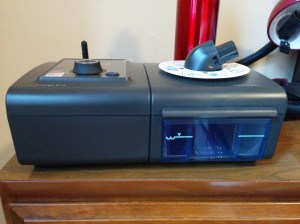
I mentioned the other day that I’ve been having some sleep issues. And I’m certain the problem is my CPAP machine.

What I didn’t explain is that I emailed my doctor about a it a couple weeks ago. He was on vacation. So I emailed him again when he returned. His vacation was extended. So I tried again after the extension was supposed to end. In the meantime, I 2014-04-23 11.03.16worked on getting a new mask and tube to replace the old, worn out mask and tube from my CPAP. When that didn’t fix the problem, I emailed my contact, C, at the company that provides my CPAP machine. He was out of town and said he’d check my data on Monday. Thanks to modern technology, both my doctor and the CPAP company get all sorts of information transmitted wirelessly about my breathing and machine usage each night. It’s pretty awesome.
Monday came and went and I didn’t hear back. So I emailed C again. Then today I emailed him again. Finally, he wrote back. He attached a sheet full of charts and graphs of my data. He explained that everything seemed to be functioning just fine, but that if the problem continues, the machine is under warranty and can be exchanged.

Now, I fully admit that I can’t understand most of the data. I don’t know what the abbreviations mean, what “normal” ranges are, or anything else about it. But I know how I feel. And I didn’t feel that the machine was functioning properly. Either the machine was malfunctioning or my breathing was broken. But I could feel that it was the machine.

So I told him so.

I wrote a respectful email saying that I don’t know how to interpret the data, but I know something is wrong, and it’s creating enough of a problem for me that I don’t want to wait to address is. I asked how we should proceed. And I hit send.

You see, there was a time when I would have followed C’s suggestion of giving it more time. But now I know better. Now I know how many times a medical provider has told me that I wasn’t interpreting my body correctly, and weeks, months, years, or a decade later I would find out that I’d been right all along. I refuse to let that happen again. So I pushed.

A moment after I hit send on that email (the world is full of odd coincidences) I got an email from my doctor. Finally. And it started with this line: “The data seems to mirror your description.” He went on to explain the problems he saw in the data. I immediately copied his message and emailed it to C at the CPAP company. My doctor had said that his office would contact the company, but it was already after 5pm and I wasn’t about to waste another minute!

C wrote back immediately: “Dr T certainly knows his stuff.” That was his way of admitting his error. The doctor was right. He said that he would make the change right away, but that it might take up to 24 hours to take effect. So I don’t know if it will work tonight, but I know I’ll sleep well knowing that I listened to my body and stood up for myself despite pages of data that said (by one interpretation) that I was wrong. I’ll sleep well knowing that I didn’t question for a second how I feel. Sometimes pushing for what I feel is right is so damn hard, but if I can get someone to listen, then it’s always worth it. Because in the end, I don’t care about the numbers. I care about how I feel. And if I feel that something is wrong, then it is.


Caught in a negative sleep loop

July 20, 2014

It’s no secret that I have sleep issues. I’ve had sleep issues for as long as I can remember. My mother says that as a toddler, I didn’t nap. I remember pretending to nap in preschool so the teachers wouldn’t get mad at me for being awake. I would lay there quietly, feeling restless and bored. Things didn’t get better as I got older. My point is, sleep problems aren’t new to me. But they’re still a pain in the ass.

I got diagnosed with a form of sleep apnea earlier this year. Using a cpap machine has made a huge difference. Or at least, it 2014-04-23 11.03.16did. My problem is that the mask needs to be replaced every 3 months, and I noticed a huge difference in my sleep about 2 weeks before that 3 month time was up. But when I reached the 3-week point, I had some insurance issues, so the company wouldn’t give me a new mask. I get it from their point of view – they had no one to bill but me, and I wasn’t jumping to pay $400. Still, this was a real problem. I waited anxiously for Medicare to come through, or for Medicaid to be more solid, or something. Then, finally, I got the insurance issues temporarily settled and I got my new mask a few days ago. Relief was in sight!

But it didn’t work. It got worse. Sleeping with the cpap right now is only marginally better than sleeping with out it, and sometimes it’s worse. My adrenal insomnia has returned. When it started last year, I had no idea what was happening. I’d be sleeping normally, then wake up around 3 or 4am, and it would take 1-2 hours to get back to sleep. I finally found other people mentioning it in some of the thyroid and adrenal online groups. It has to do with a change in cortisol levels around that time. It was making all of my sleep and energy problems worse. It didn’t happen every night, but I didn’t know which would be the nights it would hit me. I was so glad when they disappeared completely with the arrival of the CPAP machine. I was sleeping through the night again!

And now it’s back.

Twice in the last three nights I had that adrenal insomnia. Twice I found myself awake at 4am. Twice I have woken up feeling like a zombie. And the night in between I slept straight through for 10.5 hours and woke up feeling unrested. Not exactly an improvement.

I would love to go to a picnic this afternoon, but I wonder if I should just stay home and rest. Some friends invited me to watch an outdoor movie with them, but I’m thinking I might be better off having a quiet night at home. Then again, since I seem to be caught in this miserable loop, maybe I should just go out anyway, because chances are, no matter what I do, I won’t be sleeping well tonight.

[Note: I have messages waiting for both the CPAP supplier and my sleep doctor, so I’m hoping that one or both of them can help me figure out what’s going on. But today is Sunday, so I won’t be seeing any improvement tonight, unfortunately.]


What I really mean when I say “I don’t mind”

July 16, 2014

Many of us project our feelings onto other people. I hate mushrooms, so you must also hate mushrooms. I would love to go to Europe, so I’m sure that guy over there wants to go to Europe. It happens a lot. But when it comes to my health issues, it bothers me when people not only project their own feelings onto me, but then don’t accept my corrections.

I try to be polite and not complain about things. So sure, maybe I won’t say if something is bothering me. But I don’t lie. So if I say that something doesn’t bother me, then it does. If I say that it does, then it does. Simple, right? You would think so. But you’d be wrong.

I went to a wedding this weekend. Of course my health problems limited me and altered my activity a lot. Some things I minded and some I didn’t. I minded having to leave the rehearsal dinner early. I minded not being able to walk around the city more during my free time. I minded not being able to dance at the wedding. I minded having a racing heart and horrible nausea for several hours one night. I minded leaving the wedding early. I minded the pain I was in. I minded a lot.

What I didn’t mind was the food.

It’s not like I expected to eat the way everyone else ate. I made it clear to the bride and groom that I was very appreciative of their accommodations for my diet. They got me special meals that I could eat. It was fantastic of them. They weren’t the problem. It was others.

I spent too much time at the rehearsal dinner answering my table-mates questions about my special meal. They kept expressing concern that I couldn’t eat this or that, and I kept saying that I didn’t mind. Then the same thing happened at the wedding itself with different table-mates. I wanted to just talk about normal things, and instead I answered all sorts of questions about what it means to be gluten-free, how I handle it, etc. Again, they felt bad I couldn’t eat all of the rolls, desserts, and other foods. Again, I assured them that I didn’t mind.

Because I didn’t mind!

Food is important to many people, and I don’t just mean as a source of nutrition that keeps us alive. People have emotional associations with food. People think food is terribly important. I’ve gotten sick off of food for about 20 years now, so I would be happy to never eat again if there were pills I could take instead. I have some positive associations with food, but more negative ones. And even if I really do want to eat something, I want to not feel sick even more. I don’t feel like I’m “missing out” when I avoid eating something, as long as I can eat something else then or soon after.

But too often, people don’t believe me. They think I’m just being polite. They think I’m downplaying my despair at not being able to eat the same food that they eat. I wrote about this a while back with “The oh-I-could-never-do-that response” and this disbelief is just a projection of that feeling. Apparently many people can’t imagine that anything could ever be more terrible than missing out on, say, a piece of wedding cake, and so they express sympathy, because eating cake is so important to them. As if missing it is the most horrible thing happening in my life. I wish.

So for all of you out there, the next time someone says they don’t mind missing out on something because of their health, consider the possibility, just for a moment, that they mean what they say. Consider that some things just aren’t as important to them as they are to you. Because maybe, just maybe, that’s the truth.

What about you? Have you had someone doubt you when you say you don’t mind missing something? Do you get frustrated when you say you have to miss something and your needs aren’t respected? Is it difficult to explain why you mind missing some things and not others? Please share in the comments!


What would you say is “real” about chronic illness?

July 10, 2014

I thought about starting this blog for a while before I actually did it. What finally pushed me to get started was one too many “inspirational” stories. You know the kind. Someone who had a leg amputated climbs a mountain and we should all be inspired blah blah blah. Now, I think it’s great that someone can do that. What bothers me is that it gives the impression that 7-10-2014 5-46-47 PMwe can all get over our disabilities if we just try hard enough. Yeah. That’s just not how it works.

I didn’t know how many others felt the same way, but I wanted to write about the reality for me. I wanted the people close to me to understand a bit more about how it really works. And at the same time, I wanted other people with disabilities and chronic illnesses to see that they weren’t the only ones suffering on the couch instead of climbing mountains. It turns out I wasn’t the only one who felt that way; my most-viewed and most-commented on articles are the ones about things we don’t usually discuss publicly, like pooping on a guy during sex, boob growth from Prednisone, feeling guilty about making others worry, the frustration of not knowing why I feel so crappy, the frustration of seeing doctors who won’t or can’t help. I bet you’re nodding along to at least one of these. And I bet at one time, or maybe even before you read this, you thought you were the only one who felt that way. I know I did. It’s sad how alone we can feel with these illnesses.

That’s one reason I love the idea of a bunch of people sharing stories all in one place. Blogging is great, but I think we all know it can be hard to follow multiple blogs. And when you don’t even know what’s wrong with you, how do you know which ones to follow? That was my problem for a long time (but with books, in the days before blogs came out.) Plus, maybe I’m old-school, but I love the idea of a book. So I don’t know about you, but I’m going to participate in this project for an anthology about chronic illnesses. The hard part will be deciding what to write about! There are so many possibilities to choose from!

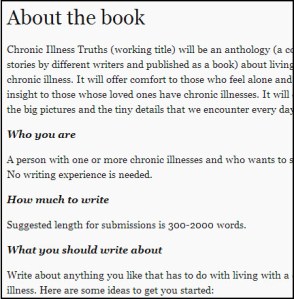
I don’t usually write posts about projects like this, but I also don’t usually participate in them. And this is also my way of helping out with a signal boost. Anthologies usually don’t get published unless there’s significant participation (dozens or even hundreds of articles submitted) and under “How you can help” she asks people to pass along the word about the project, so at least by writing this, I’m doing my part (plus I’ll post to Facebook and Twitter, too.) If you want to help spread the word, you can share the link to this blog post or to the project itself: http://chronicillnesstruths.tumblr.com/aboutthebook

If you’re thinking about writing, consider this line taken from the “How you can help” section at the end: ” If you want to see more voices like yours in books like these, here’s your chance!” That’s good enough for me!