When or if I get better?

August 13, 2013

I will never be completely healthy. I accepted that reality a long time ago, and I’m ok with it. Please understand that I’m not happy about it, but I am ok with it. There’s a difference. The thing is, my health took a real dive a couple of years ago, right around the time I started this blog. In hindsight, that’s probably why I started writing it when I did, but at the time I didn’t realize what was beginning; I thought it was just another temporary flare.

So now when I talk about getting “better” I’m not referring to being 100% healthy. I’m just talking about getting back to where I was a few years ago. I’m talking about being well enough to work and date and travel and go out with friends. I’m talking about being able to do laundry and cook and leave the house all in the same day.

For the last two years or so, I’ve been referring to an optimistic future of that sort as “if I get better.” I knew it might not happen. I wasn’t trying to be pessimistic – after all, I was still speaking of it as a possibility. I hadn’t ruled out that it could happen, I just wasn’t so sure. So I said “if” a lot. And then today I caught myself saying, “when I get better…” I immediately stopped and correctly myself to “if” but it had already happened. The “when” was out there, hanging in the air.

I’ve been more optimistic lately. I’ve finally gotten to see two excellent doctors who I’ve been waiting a long time to see. I have several different treatment methods I’ll be starting soon, and any one of them, or possibly all of them, could really help me. I’ve been feeling better for a few weeks, too. The improvement is quite noticeable. Sure, I still can’t do everything I want to do. Yesterday I did laundry, and then had to choose between grocery shopping and seeing friends because I still couldn’t do all three in the same day. (Note: I chose to see friends. Until recently I wouldn’t have made that choice, but I felt well enough to know I could manage to get groceries today, which I did.) This improvement could be temporary or it could be just the beginning of further improvements. I don’t know. I can’t know. But I can hope. And for the first time in a very long time, I do have hope.

So maybe I’ll get better. Maybe I won’t. But the hope is enough to make me switch from thinking about “if” to “when.” And when I get better, boy will I celebrate!


The eny, meeny, miny, moe method of choosing a treatment

August 9, 2013

When a doctor presents multiple treatment options, my favorite question to ask is, “If I were your

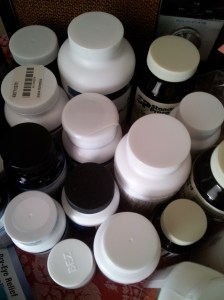
Too many pills!

Too many pills!

sister/daughter/best friend, what would you suggest I do?” This usually makes them stop and think about things in a slightly different way. I preface it by saying that I know it’s ultimately my own decision and I won’t hold them to whatever they say. This has produced some interesting responses over the years.

Right now, though, that isn’t working. Right now I’m choosing among treatments in different specialties, so there’s no one doctor (that I know of) who’s familiar with all of them. I did ask the hematologist this question yesterday, which is how I decided to do iron infusions. But maybe I shouldn’t? Another doctor prescribed hydrocortisone (HC) for my adrenal insufficiency but my naturopath thinks I should keep taking Isocort. That doc isn’t familiar with Isocort. But then, I’ve also received a new thyroid-related prescription, NDT. I can’t do all of these at once, and maybe I shouldn’t do all of them at all!

It’s generally agreed that the thyroid can’t heal until the adrenals are properly supported, so if I’m going to do the HC then I need to do that before the NDT. Some say NDT won’t work if the patient is iron-deficient, so I guess I’d have to do that first. But again, that’s if I do these treatments at all. They all have risks of side effects. What if I do the iron infusions first and have some bad effect and it takes me a long time to recover, and that makes me put off the HC and NDT, which are both promising? Of course, the HC has lots of potential side effects that I’d really rather avoid, too.

It’s overwhelming. This is my body. This is my health. This is my life. I don’t want to fuck around here. It’s too important to just randomly guess. And yet, sometimes I feel like that’s all I’m doing anyway. Right now I’m looking at three new treatments. Those are in addition to my current supplements and my complicated diet. Maybe one or more of them will work. Maybe they’ll make me better. Maybe they’ll make me worse. But I have to try, right? Yes, I have to at least try.


Why I’m against the way we dispense the birth control pill

July 31, 2013

I was put on “the Pill” the week I turned 18. I wasn’t put on it for birth control purposes, but because my previously-heavy period had gotten so bad that I passed out from the loss of blood. The doctors figured this would fix that problem.

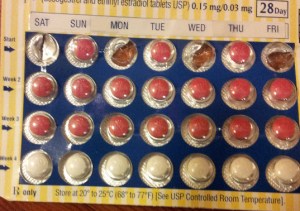
Birth control pills

What it did was mask the problem. Once I was on birth control pills (BCPs), I could no longer have accurate hormone tests run. The specialist thought I had PCOS (polycystic ovary syndrome) but it would be another 7 years before I found out he was right. In the meantime, I just dutifully took the Pill every day, as instructed, and assumed I wouldn’t get pregnant and that everything was under control. My primary care physician (PCP) du jour always prescribed it.

A friend of mine was suffering from depression for a long time. She tried changing all sorts of things about her life. She got a new job, tried a new diet, saw therapists, but was still depressed. I saw her a few months ago and the transformation was incredible! She was the happy, upbeat person I remembered from so many years ago! She was dealing with some truly horrible circumstances at home, and yet she seemed happier than I had seen her in 10 years. What changed? She went off the Pill. She said the change happened quickly. She’s no longer in therapy. She’s just avoiding birth control pills. Too bad none of her doctors thought to try that. Apparently, it never occurred to any of them.

A friend of mine found out the hard way that because of a medical condition, birth control pills won’t prevent pregnancy for her. She found when she got pregnant!

I now take a half of a BCP every day. I do this not for birth control, but because I need the boost in my estrogen levels. This is how my endocrinologist prescribes it.

Hormones are a tricky thing. Mess them up, and you could be in serious trouble. I know this from experience and from what I’ve witnessed. So why are PCPs prescribing hormones? Why aren’t women being sent to endocrinologists? Now there’s even talk about making BCPs available over the counter, without prescription!

Let me be clear. I am very much FOR giving women better birth control options. I think that making BCPs widely available is a good thing, but it needs to be done intelligently. Women should receive free visits with endocrinologists. Only endos should be allowed to prescribe BCPs. Endos should be well-versed in the possible side-effects of BCPs. When I got horrible mood swings once a month, when I felt horribly depressed and wanted to cry for no reason, my endo knew to take me off the Pill, let my body settle down, then start me on something else. My PCP didn’t know to do that. After women get these free visits, then BCPs should be available at the local pharmacy free of charge. I strongly believe this.

On the other hand, I do not want to see women getting the Pill without seeing a doctor. This is an unpopular view among my very liberal social crowd, but having more experience with medical issues, I am very ready to confidently take this stand. There are just too many ways it could go wrong. There are women for whom BCPs won’t work as effective birth control, and many for whom it can have horrible side effects. We call it “the Pill” and yet there are many different formulas. Should I take an estrogen-based one or a progesterone-based one? I like the idea of only getting my period 4 times per year, but will that one work for me? I could ask the pharmacist, but what will they know? They have no idea what my hormone levels are. No, women need to see endocrinologists who know which tests to run, how to interpret them, which medications to prescribe, and how to handle the side effects.

Our bodies are too important to just hope that it all works out.

And by the way, if providing free birth control is so important, where are the free condoms? I don’t want to get pregnant, but BCPs won’t work for me, so I need something else (assuming I’m even fertile, but that’s a topic for another day.) Plus, I don’t want to get STIs, either! Condoms should be distributed at doctors’ offices and at pharmacies, free of charge. Those things are expensive! Let’s make it easier for everyone to avoid unwanted pregnancies and STIs.


Inexcusable insurance stress

July 29, 2013

For a while now I’ve been on MassHealth. That’s the Massachusetts version of Medicaid. If you don’t live in the U.S., Medicaid is health insurance for the poor and the disabled. It’s partially funded by the federal government but it’s administered by the states. This means that the type of coverage you have, and if you’re even eligible, is based on where you live. Ridiculous, right? Thankfully, I live in Massachusetts, where I am eligible for MassHealth. In other states I wouldn’t have been able to get it.

Of course, that was before. Now I’ve won my long term disability appeal, so I’m getting my old health insurance reinstated. You’d think that was a good thing, right? Wrong!

Obviously my old insurance costs a lot more than MassHealth. I was on MassHealth not as someone with a disability (don’t get me started on that!) but as someone of low (in my case, nonexistent) income. So I didn’t pay premiums or copays, and I paid only tiny amounts for prescriptions. And my old insurance is used by more doctors, so in theory that’s good. But here’s the problem: referrals.

In Massachusetts, most health insurance plans are HMO. That stands for Health Maintenance Organization, but as far as I can tell their just trying to maintain their balance sheets, not our health. HMOs require that all doctor visits by approved by the patient’s primary care physician (PCP). If I want the insurance to cover any appointment with any specialist (except for eye care, for some reason) then I must get a “referral” from my PCP. This sounds good, until you consider the reality:

  • Many PCPs want to discuss each situation, so that means time, effort, and money (yes, we pay to see PCPs aside from yearly checkups) for each discussion.
  • The PCP can say no because they don’t think you need to see that specialist. That’s one of the reasons it took eleven years for me to be diagnosed.
  • The PCP can say no because they’d rather you see another doctor. Usually they want you to see one within their own hospital network.

I did my research. I asked around. I figured out exactly who I should see. Sadly, they took my old insurance but not MassHealth. I waited many, many months. Then, finally, they started taking MassHealth! I got the first appointment I could, for this Thursday. You see, with MassHealth, specialist referrals aren’t necessary – I can see whoever I want as long as they take my insurance! What a novel idea!

But here’s the thing: I can only use MassHealth as long as I don’t have access to another health insurance. But now that I’ve won the disability insurance case and I’m getting my old health insurance back, I’m going to lose MassHealth. Sadly, the changeover is due to happen on Wednesday. Yes, just ONE DAY before my big appointment! So after waiting for about a year to see this doctor, it all comes down to needing a referral from my PCP.

I called my PCP’s office today. They said they’d run it by her, but told me she usually doesn’t refer to anyone outside of her hospital network. Now, I’m completely willing to leave her practice. In fact, I plan to leave it anyway. But there’s no way I’ll be set up with someone else by Wednesday. That just isn’t possible, especially because no PCP gives a referral before having a first meeting with a patient. So now I’m worried that I’ll miss out on my big appointment and that I’ll have to put it off even longer, all because my PCP may not give me the referral.

The inexcusable part? She wouldn’t withhold the referral because the doctor I want to see is the wrong specialist for my condition or because he has a bad reputation. She would withhold it only because she prefers to have her patients seen within her hospital network. There are advantages to that, of course. She knows the physicians, the medical records are all within the same system, etc. But it is also very limiting. I’ve researched those doctors and they don’t do the treatment I want. The treatment I want is less common, but by no means experimental or unconventional.

I should be confidently awaiting my big appointment, looking forward to new treatment possibilities. Instead, I feel stress that it may not happen. Is this the medical system we deserve? How have we let it deteriorate to this point. This is simply not acceptable.