My calendar says I’m recovering that day

April 19, 2016

I used to call them do-nothing days. Or resting days. Or dead days. Lately I’ve been calling them Recovery Days. Because that’s what they are. I’m not doing nothing, I’m recovering!Recovery Day
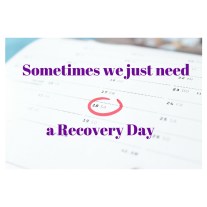
Our culture says that a day of watching tv when you should be buying groceries and cleaning and going to a job and and and…. is lazy. I say that if you have a chronic illness, sometimes it’s necessary.

I had a recovery day yesterday. I could have pushed myself. I had a long list of things to do. If I’d pushed myself I might have been able to get a couple of things done. But I wouldn’t have gotten far on that list, and I would have done things badly. Then I’d have felt lousy today and I’d have barely gotten anything done at all. Sound familiar?

I used to push myself. At the time it seemed like a good idea. Now I know that pushing myself too much just means I’ll eventually hit the wall and I won’t be able to do anything at all.

So instead I took a Recovery Day. I didn’t leave the apartment. I read. I watched tv. I heated up leftovers for meals. That was it.

And today I felt better! I was able to go out and run errands. I’m sitting in a chair and writing this now (not an easy thing!) For me, that’s a super productive day.

Sometimes my Recovery Days are predictable. I can look at my calendar right now and tell you that I’ll be taking a Recovery Day on Sunday, so that’s blocked out on my calendar. I knew I’d probably be taking one yesterday, too, but I wasn’t completely sure until around 10am. I could just feel it, and there was no doubt it’s what I needed.

I used to take Recovery Days 3-5 days per week. If I left the house for an hour, the next day would be a Recovery Day. These days I’m feeling better and I only need them 1-2 times per week – yay! Of course, even now I have bad weeks, too. Sometimes a Recovery Day means spending all day in pajamas and doing nothing but watching tv. Sometimes it’s multiple days of that. Yesterday I felt better and was able to read a novel for a while. All that really matters, though, is that I gave my body the rest that it needed, in the form that it needed.

I know I’m lucky. I don’t have children or anyone else to take care of. I’m not working (though that’s not exactly a good thing.) So I’m able to spend an entire day indoors. I’m able to rest when I need to. But there are other things I should do on my Recovery Days that I can’t. I accommodate myself the best that I can. That’s all any of us can do.

You might have noticed that I’ve been capitalizing Recovery Day. That’s because it’s IMPORTANT! I think we don’t give ourselves enough credit for how hard these days are. We let culture pressure us into thinking we’re not doing enough when in reality we’re doing so much. Sometimes, it’s all we can do to get through these days. I’d rather go to the gym for 4 hours than need some of these Recovery Days. But I don’t have a choice, and I accept that (but it took me many years to finally accept it.)

How do you feel about your Recovery Days? Are you willing to rest when your body needs it? What do you do? How do you handle it? Please let me know in the comments so we can learn from each other!


Package excitement: oh how things have changed

March 30, 2016

There was a time when getting a package in the mail was an exciting thing. It still is. But in2016-03-30 12.35.09 a very different way.

As a kid, a package was a birthday gift from a far away relative. In college it was brownies and cookies from my aunt. As Amazon and other online retailers came on the scene not long after I left college, a package meant a book, an electronic gadget, or some other purchase I made for myself. I’m a bit embarrassed by how I wasted my money, but some of these purchases were really useful. Regardless, when I saw a box with my name on it, it was exciting!

I was thinking about this earlier this week when I opened a box and felt a different kind of excitement. It’s here! Finally! This box didn’t contain a book, an electronic gizmo, or new shoes. It wasn’t fun or exotic. It was….

New medical supplies!

An ASV is like a CPAP machine – it helps me breath while I sleep. )It’s used for an unusual form of sleep apnea called central complex sleep apnea.) Every few months insurance will cover a new set of supplies – a new tube and new mask. Right before I become eligible for replacements, I can feel the current ones losing effectiveness. So I was super excited for my new supplies. It meant breathing at night would be even better, and when I breath better at night, everything in my body feels better the next day!

Part of this change, of course, has to do with money, or lack thereof. I’m simply not buying stuff online as much. Part of it is age. Relatives don’t send gifts anymore. If they want to give a gift, they give a check. Don’t get me wrong, I love and appreciate checks. But they aren’t fun like gifts are. They aren’t surprising. (Then again, I also don’t get stuck with things I don’t like.) But part of it is my health. My healthy friends don’t get medical supplies in the mail. And most people who get medical supplies probably aren’t excited by them. But I’m excited by anything that makes me feel better.

And if that small improvement in health comes in a box in the mail, then you can be damn sure I’m going to be super excited!

What about you? Can you relate? How do you feel about getting new medical supplies? Please share in the comments!


There’s no such thing as a chronic illness schedule

March 21, 2016

I used to work in an office. Back then, my chronic illnesses were more manageable.

Then I worked in an office 4 days a week and from home the 5th day. That helped. But eventually, that wasn’t enough.

Now I don’t have a job at all. Still, I’ve been making some money here and there when I can. Consulting work has gone ok, but I’d like to do something different. The problem with consulting is that I have to be ready to work at a particular time and place. Sure, I can often schedule the at-home part of the work whenever I want, but I have to meet with clients too. That part is really tough with a chronic illness. And that means I can’t take on as many clients as I need to.

I like the idea of “passive income.” With this method, I do the work up front and the money comes in later, without me having to be present at a particular time and place. For example, imagine I wrote a book. I’d put in a lot of effort up front on my own schedule to write it and market it, then when it came out I’d do some more marketing, but it would be less work at that point. The money would come in, but I’d have already done more of the work from the comfort of my living at my own pace. Sounds good, right?

The thing is, the work still has to be done. And I’m having trouble making that happen consistently.

I’ve found some other people who are trying to do similar things. One is married, has a young baby, and works a full time job, yet she works on her business more consistently than I work on mine. Then again, she doesn’t have a chronic illness. That doesn’t mean her life is easier or that she has more hours in the day. I’m constantly amazed by how productive she is. But it does mean that her schedule is fairly predictable. She works on the bus to and from her job each day. She works at night after the baby is in bed. She carves out time every weekend.

By comparison, I can’t even get a morning routine going. Some mornings I wake up and can do work within an hour or two. Other days I’m not able to do any work at all, and I go to bed without having even tried. Some days I get a lot done, but it has nothing to do with the new business. Today I wrote a blog post for that business and did a bit of reading. That’s not too bad. I also filed away some personal papers, sold something on Craigslist, did a ton of texting with various people, fixed something small on my mother’s computer, cleaned out my email inbox, made some phone calls, prepared an easy dinner and did the dishes, and took a shower. For someone else, that wouldn’t sound like much. Except for dinner, they’d do all of that before they left for work in the morning and on their lunch break. But for me, that was a lot. I had a busy weekend and I didn’t feel great. I never went outside. I wanted to bake, but never got to it. In fact, there’s a lot I wanted to do that I never got to. But I feel good about having done all of that. For me, that’s really big!

And that’s the problem. The every day things in life still have to be done, and I never know which days I’ll barely be able to get those things done and which days I’ll have the energy for a little extra. That means I can’t set a schedule.

I would love to say that I’ll get up at 8am every day, eat breakfast and work until 11am, exercise (ha!) and eat lunch, do personal stuff until 3pm, then have the rest of the day free. Or maybe do more work in the afternoon. But I can’t do anything like that. Every day is so different. Today I’m in too much pain to walk down a flight of stairs. Another day stairs are no big deal. Some days I can’t doing any writing because my brain just won’t function well enough. Other days I zip off a blog post in 1/2 hour. There’s no way to plan it. It just is.

It’s hard to explain all of this to the other entrepreneurs I talk to. They can’t understand why, without a job, I can’t put in more time on my business. And I get frustrated that even on my best days I can’t put in as much time as they do on their worst. I’m trying, but it’s just not working.

I know I need a schedule of some sort. That’s how I work best. This fit-the-work-in-when-I-can method means that other things get in the way and I end up answering emails and scanning Facebook instead of working. I need a better method.

If only I knew what that was.

Edit [3/23/16]: I just came across this post today (good timing!) and want to share it. If you’re looking for a way to earn some money yourself, maybe it will give you some useful ideas.


When the government forces pain upon us

March 17, 2016

This week there was a difficult statement from the Centers for Disease Control. Well, difficult for people with chronic pain and their doctors.

There has been a lot of discussion around the use of opioids for treating chronic pain. It paints all users are addicts. It suggests that the deaths caused from addiction negate any benefit that might be gained from proper use of the meds. It suggests that there is no such thing as proper use. And so on.

For the record, I do not use opioids. I have tried them and have always found that they helped me very little and that their side effects were terrible. If they worked for me and didn’t have bad side effects then yes, I would use them every day if that meant living with less pain.

Also for the record, many close friends take opioids daily. They are not addicts. They take their medications responsibly. These medications allow them to do heroic tasks like shower, cook, and drive to medical appointments. Occasionally they can even do something fun, like have me over for a visit.

This week the CDC issued a guideline. This is non-binding, but it does usually have an effect on doctors’ practices. I won’t get into the details here, but they’re linked at the bottom of the article below. Suffice it to say, a bunch of people who don’t have chronic pain have decided that those with chronic pain don’t need opioids. Apparently Tylenol and Advil should be sufficient. In other words, they’re completely clueless.

I find this whole thing very upsetting. So on the one hand, I think it’s incredibly important to talk about it. On the other hand, I don’t feel qualified to properly and fully discuss it, and I find it upsetting to even try.

Here are just a few of my thoughts:

  • Lumping together all opioid deaths, including those from heroin use, is hurtful, hateful, and absurd.
  • How can they not be accounting for the increased suicide rate that will result from this? Do they not care, or do they not understand?
  • Do they really think people would take medications with terrible side effects if Tylenol and Advil (which aren’t harmless, by the way!) really worked?
  • Do they have any idea how many different things pain patients try? Do they know how many more things we would try if insurance covered them? I have such a list of things I would do if I only had the money and the energy!
  • Have they not considered that maybe, just maybe, limiting the use of legal drugs will lead to an increase in the use of illegal drugs?
  • If the concern is addition, why not work to prevent and treat addiction? Studies have made it clear that this won’t help.
  • Where is the compassion?

I want to say so much, but I don’t have the words. So here are some reactions I want to share. At the bottom of that article is a link to the CDC guidelines.

The chronic pain community put up a good fight and lost this round. But the fight isn’t over. I don’t know what will happen next, but I know that no one will be giving up!
