The joy and joint pain of autumn

September 18, 2012

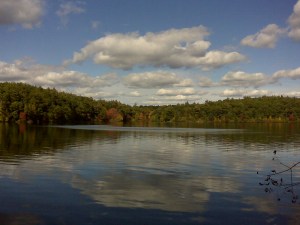
I love autumn.  The heat and humidity of summer are gone, and with them a lot of my extra fatigue and other symptoms have gone.  And it’s pretty.  The sky is clear most days, the leaves change colors (they’re just beginning now,) and the air is crisp.  I’m happy every time I look out the window and see the lovely weather.  This picture is from last year, but you get the idea.
Of course, right now we’re in a transitional time.  Right now, summer is mostly over, but not quite.  And it’s mostly autumn, but not entirely.  We haven’t transitioned completely to the cool days yet.  Sometimes I’m hot in a t-shirt and sometimes I need a sweater.  It’s mixed.

And we all know what that means, right?  If you don’t experience worsening symptoms during spring and fall, then you’ve probably heard from others who do.  My rheumatologist says that her phone rings constantly in the spring and fall.

For me, spring is definitely worse.  My body seems to know that bad times are coming, with summer on the way, so it goes haywire.  But autumn isn’t the easiest thing either.  For the last couple of weeks, it seems to have manifested itself as worsening joint pain, especially in my fingers and wrists.  Now, I’ve had pain in these areas for more than 20 years, so it’s not like I can’t handle the pain itself.  What’s bothering me is that no movement causes stiffness, and small movements from fidgeting makes it worse.  Big movements are good, like washing dishes or cooking or sorting through a pile of books (as long as they aren’t too heavy.)  And the problem is that I just don’t have enough of these big movements to keep my joints happy.  I’m home a lot these days, so I’m open to suggestions for things I can do at home to keep my fingers and joints useful without using up too many of my spoons.  Typing on the computer or reading or watching tv all seem to be bad things for my achy hands, and that’s how I usually fill my days, so I’d love some new ideas.

How’s autumn for you?  Is it a rough transition, or is your body just glad to be out of summer?

Good luck during the changing of the seasons CI folks!  At least it’s pretty.


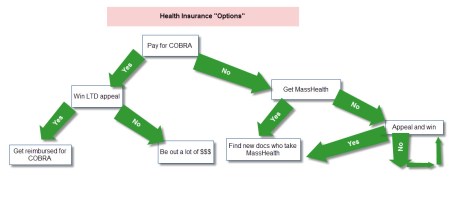
Health insurance “options”

September 4, 2012


My hopefully-realistic ideal

September 2, 2012

Like I said the other day, I have reason now to hope for improvement for the first time, but it worries me.  Still, I can’t help but think about the future.  So instead of thinking of it as “hope” I’ve decided to create “goals.”  The difference is that hoping for something better is a bit vague.  Goals are more specific.  And I know that the goals may not happen, but I can still hope to reach them.  Well, let me demonstrate:

I often wonder if I’ll be able to return to work some day.  When I left my last job, my health was pretty rotten.  I was working full time and not doing much else.  I wasn’t exercising, socializing, or growing as a person (except for my stomach.)  If I go back to work, I need to be in a better place, one where I can work and also do other things.  Crazy, right?  But what if….?

So that begs the question, what other things do I want to do besides work?  And here’s what I’ve come up with that I think is realistic:

  1. I want to be able to wake up an hour early every day and exercise.  I have never been a morning person, but in recent years I just couldn’t have managed it even with the best of intentions.  I want to be able to wake up and get out of bed within a few minutes, instead of spending an hour gathering the energy to get up.  I want to be able to do light exercise without first loosening up my muscles and joints for several hours.  I want to do physical therapy or take a walk to start my day.
  2. After exercising, I want to get ready for work, then go to work for a full day.  I don’t know yet what kind of work it will be, but my goal will be to avoid desk jobs.  This should be interesting, since I’ve always had desk jobs, but I want something more interesting, and I want the energy to do it, whatever it is.
  3. After work, I want to do something other than watch tv due to a lack of energy to do anything else.  In fact, I want to not own a tv.  Instead, I want to spend 1 or 2 weeknights each week meeting up with friends or going out on dates.  The other evenings I want to read books, work on hobbies, and learn new skills.  I have a few ideas for new skills, such as learning to sing, learning a new language, and learning web design, but I might end up doing something else.  I definitely want to do some form of self improvement, though.  I will also use weeknights to cook, do laundry, and take care of other chores.
  4. I want to walk more and drive less.  I’d really like to ride a bike, but I think that’s not so realistic for me, so I’ll stick to walking and public transportation as much as possible.
  5. On weekends I want to go out each day if I so choose.  A day at home should be because I want a day for myself, not because I am too tired to leave the house.  Weekends should be for the same things as weeknights, but more so.  I want to spend time with family and friends, work on hobbies, and learn new skills.
  6. Each night I want go to bed at a reasonable hour, then wake up 8-9 hours later and get right out of bed in order to exercise.  I want to get tired at night before I go to sleep, but at no point will I be fatigued.

I have been thinking about this for a very long time.  When I started writing this, I was worried that it wouldn’t be so realistic after all but now, seeing it all laid out at once, I’m realizing that this is the very least that someone should aim for.  Maybe my goals should be higher, maybe not.  I do believe that these goals are realistically achievable if my health improves, and I know that I will not go back to work unless I can achieve them, so for me this feels about right.  And I’m pretty sure of one other thing: if I do manage to achieve these goals, I will be happy and content.  I will continue to aim higher after I reach them, of course, but I will not be upset if this is as high as I can get.  To me, this looks like a pretty fantastic life.


Suspicious of hope

August 30, 2012

We mourn the loss of our health the way we mourn other losses.  For me, I went through the 5 stages of grief back in my teens, when I realized the daily pain was going to be a permanent part of my life.  Then I went through them again at age 23, when I was diagnosed with an autoimmune condition for the first time.  These were different kinds of losses.  First I had to accept the current symptoms, then later I had to accept that things might get worse eventually.

About 10 years later, now I’m experiencing something new: hope for improvement.

At first, with the pain, there seemed to be no point in hoping for improvement.  After the initial rounds of doctor appointments, tests, and surgery, it was clear nothing would change.  I could accept that, because its effect on my life felt limited.  Unpleasant, horrible, obscene, but limited.  Later, with the autoimmune diagnosis, there still seemed to be no hope for improvement, and I foresaw a very difficult life ahead, but that was in the future and I was living in the present, so even though it was in a part of my mind, I tried not to focus on it.  More recently, of course, my life was altered drastically, and I didn’t feel anymore like I was really living my life, but more like I was just trying to get through it.  This is no way to live, but what choice did I have?  And that’s where the hope came in.

Now I picture my future as being better than my present and that worries me.  I worries me mostly because I have no idea if it will be true.  I picture a better future in part because I have some medical reason to hope, because I am pursuing new treatments and so far they have helped a bit.  But I also picture a better future because I refuse to picture a future like my present, or possibly even something worse.  I picture a better future because it’s what I have to live for, and I need that ideal.  But is it realistic?  Is it even possible?

I am scared to hope.  I am scared that I will get my hopes up and will then be crushed when I don’t improve.  My dreams are simple: to go back to work, to date, to travel a bit, to maybe even have a family one day.  But to anyone who has been ill like this, these dreams aren’t simple.  They aren’t easy and they aren’t a given.  Dreaming of these things could be a way of setting myself up for a huge disappointment.

How can I stop?  I honestly don’t know.  It isn’t as though I spend an hour daydreaming about what I’d do if I felt better; it’s much more subtle than that.  I hear about an interesting job, and wonder if that’s something I might want to do when I go back to work… and then I remember that I don’t work.  I remember a great trip I took and think about going back… and then remember that I can’t travel.  I think about how much I should save up for my next car… and then remember that I have no income to save.  I picture moving to a smaller apartment until I meet someone… and then remember that I’m not dating.  It’s hard to shut off these automatic projections of the life that I always assumed I’d have.  I suppose that in time, I’ll change my frames of reference, but I’m just not there yet.  So should my goal be to stop dreaming?  That’s a horrible goal.  And yet…

So a part of me is continuing to hope, even while another part wants to run away from any sign of hope.  And in the end, I just hope, desperately, that a little bit of what I’ve been dreaming of will come true.