It’s ok to ask for help

November 30, 2014

I’m so used to asking for help because of my health. Sometimes it’s something simple, like today when I couldn’t turn a screw that was stuck. I thought maybe it was because of my joint problems. But as it turns out, my very healthy and very strong friend couldn’t turn the screw either, so it wasn’t just me. That felt a bit odd.

But what felt even stranger was asking for my friend’s help with something that was absolutely in now way related to my health problems. Usually the help I ask for is obviously health-related, like bringing me food when I don’t feel up to leaving the house or carrying something that isn’t heavy or large but that I still can’t manage. That kind of thing. And sometimes it’s on the edge, like turning a screw that may or may not really be stuck.

Then there are the things that are completely unrelated to my health in any way whatsoever. And that’s what happened today. I needed to reach something that I just couldn’t reach. Even on a step ladder while wearing heels, it just wasn’t going to happen. Because the thing is, I’m short. I’m very short. Well ok, I’m not that short, but I’m definitely well below average height-wise. My friend is 5’9″ and was able to reach this thing from my step ladder. No one of average height, no matter how healthy, would have been able to reach that thing, so of course I couldn’t come close.

Here’s the weird part, though: I kept trying to excuse asking for help. I kept joking about it, and insisting that I really did need the help in a way that wasn’t health related. And then I wondered why I was trying to justify the request. The friend who was helping me is one of my oldest, dearest friends. She’s one of the only non-family members in my life who knew me before I had any health problems. She has brought me groceries, fetched prescriptions, shoveled out my car after snowstorms, and carried numerous heavy objects. And I have helped her with personal things as well. If I feel the need to justify my request to her, of all people, then it’s obviously completely about me. She certainly didn’t say or do anything to suggest that I was asking for something unreasonable. She has never judged or questioned any of my requests. She often offers unsolicited help. So why was I so defensive?

I hate asking for help. I hated having my mother cut my meat for me when I was 16 and could only use one hand for a while, and I hate asking for help now. I have been judged by too many people, from strangers to doctors to the Social Security Administration, and sometimes I assume I’m being judged even when I’m most likely not. I can’t stand being seen as weak. I was a crier when I was much younger, and around the time I grew out of that, the pain began. There have always been so many things I couldn’t do, and now there are even more. I forget that asking for help is its own form of strength, and so I resist it. Yet I need help so much, and avoiding it just isn’t possible.

So when I really need to ask for help, I expect to be judged as weak, even when that’s not happening, and apparently I get defensive to minimize the weakness that’s perceived. It may not be right or necessary or even make much sense, but it’s where I’m at after more than 2 decades of pain and other symptoms, and more than 2 decades of judgement from others.

Why am I telling you this? Because I’m guessing that many of you also have trouble asking for help. Your reasons might be similar to mine or completely different, but you have your reasons. Sometimes they’re justified and sometimes they’re not. No matter what, I want you to know that you’re not alone.


Where’s my apology?

November 29, 2014

Apologies are powerful. They convey regret and an acceptance of responsibility. They are also hard to come by, especially, in my own experience, with doctors.

Over the years I have seen many doctors. Some have treated me well. Others did not. Some were dismissive, some were ignorant. I was told I was just trying to get attention or that I was imagining my symptoms. I was given misdiagnoses. I was dismissed. I was given unnecessary surgery, surgery that could have been avoided completely if the doctor hadn’t ignored some test results.

I received prescriptions, judgments, proclamations, criticism, and referrals. What I never got was an apology.

A simple example: I asked my doctor to run a test for something specific. He insisted on running a less expensive test. When I got home, I researched and saw that the test he ran was inaccurate for the problem I suspected. It came back negative. I paid out of pocket to have the test run myself and it came back positive. He accepted my test results but never admitted that he should have run the test in the first place. Where’s my apology? I spent my own money, did my own research, and spent many hours fretting over this. He could have just ordered the test, but didn’t.

And then there’s that doctor who did the unnecessary surgery. Where’s my apology from him? That was many years ago, but I’m still resentful that he was so pompous about the whole thing, insisted that it was still informative. I read the records. It gave no new information, but it did succeed in increasing my pain, weakness, and instability in that joint. He never apologized.

I know the medical field is wrought with lawsuits that cost doctors a lot of money and their reputations. So they need to be careful.

But we’re human beings, damn it! Patients are not just puzzles that, when you make a mistake, can be taken apart and put back together again. And if you break a piece, you can’t just throw out the whole box. And yet, that’s often how I feel I’m being treated.

I’m not looking for a 20 minute speech for each and every misstep. But when someone clearly makes a mistake that causes harm to another human being, the appropriate thing is to apologize. This is no less true for doctors. They should learn in medical school that saying, “I’m sorry” for their mistakes isn’t a mistake and it isn’t a weakness. Personally, it would make me respect them a whole lot more.


This never happened: When healthcare is about health

November 24, 2014

We (society) throw around the term “healthcare” a lot in political debates, media, and daily life. We use it to mean all care related to our health, but that’s not what “healthcare” really is.

Occasionally, though, someone flouts convention and choose to focus on actual health. I forget how rare this is until I 11-24-2014 10-18-13 PMregister my own surprise when it happens. Today was one of those days.

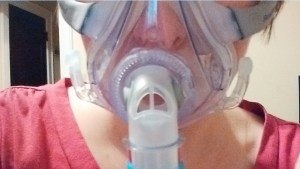
I’ve been having trouble adjusting to my new CPAP setup. The doctor suggested I get fitted for a different type of mask. The CPAP company has a guy, C, who handles this. I met with him for my original mask fitting. He came to my house to set up the CPAP the first time around. He came out to fix the CPAP when I had problems. He came back with the new setup last month. And today I saw him for another mask fitting. We greeted each other like old friends.

C showed me my two options and explained how they worked. He took his time, as if he had no other appointments. He answered every question. He never rushed me or made me feel bad for asking so many questions. Isn’t that how it should always be. But it isn’t.

I chose a new mask, excited, as always, at the prospect of improved sleep. C rummaged through a drawer, searching for the right type and size, and pulled out a new mask. He ripped open the bag, and I commented on how I didn’t expect to walk out with a new mask. He said, “This never happened,” and I grinned and agreed. It wasn’t the first time someone in the medical field had said that to me when giving me proper healthcare, and I doubt it will be the last.

The insurance coverage of a CPAP is incredibly complicated, but at best they replace the mask and tubing once every three months. The filter only gets replaced every 6 months, I think, and the machine should last for several years. I figured I was 6 weeks away from qualifying from a new mask. I asked C about that, and he explained that this never happened, and that he’d submit the paperwork next month, when the insurance would cover it. I suppose I’ll have to make this mask last longer than it should so that my supply schedule will line up with the insurance paperwork. But for now, I’m just so excited to try out the new mask tonight!

C knows his job. He knows what boundaries he can push. That’s clear. But he also clearly wants to help patients. He didn’t have to give me that mask. He gets nothing in return, except the knowledge that he’s helping me. So why did he do it?

No, that’s the wrong question. The question is, why doesn’t everyone else do it?

Nope, wrong again. The real question is, why is it necessary to do it? Why must someone break the rules to provide good healthcare? Why doesn’t our system focus on health as a top priority?

If our system focused on health, a new CPAP mask for me would be covered. So would many other things. I began to list them here, but why bother? We know what they are. I’ve discussed them so many times before. And they aren’t the point, at least not individually. It isn’t simply about what’s paid for, but an attitude. I would like medical appointments that aren’t rushed, doctors who don’t have to worry about malpractice suits at every turn, and practitioners to consult with their colleagues on every case to be sure that nothing is missed. I want to see a system where the goal of every examination, test, treatment, and discussion is optimizing the patient’s health.

Because what’s healthcare, if it’s not about optimizing health?


Watching my life change

November 13, 2014

A funny thing happened when I was busy just trying to survive: my health took a big step forward. And suddenly, instead of being in one of the negative health cycles we all know so well, I’ve practically fallen into a positive health cycle.

First I left the hell of benefits applications. I got the last approval letter this week. I’m done (for now, at least.) That reduced my stress level more than I could have imagined.

Then I started with a new CPAP setup for my sleep apnea. With a couple weeks I was noticing a difference. I still have some problems with it and, with a couple of exceptions, I haven’t been able to use it for more than a few hours each night, but it’s helping. (As a side note, I saw my sleep doctor today and I’m hopefully we’ll be able to fix those problems soon.)

Then, as I was feeling less stress and more energy, I spent a week dog sitting. I took 2 walks each day and was more active in between walks. And while it was tiring, I actually felt pretty good!

Yesterday I saw my naturopath and today I saw my sleep doctor. Unlike many of the other doctors I see, each of them ask a lot of questions about how I’m feeling take the time to consider all of the details. And that means that I have to take the time to consider how I’m feeling and to answer their questions thoroughly and thoughtfully.

I knew before this week that I was doing significantly better, but when I compared how I feel now to how I felt at my previous appointments with each doctor I saw the change more clearly than ever.

And the thing is, it’s not just that I feel better. It’s that because I feel better, I’m doing more! So you know that health cycle I mentioned at the start of this blog post? Well, it goes something like this:

Feel better physically –> Be more active –> Feel happier from extra activity –> Feel even better physically from extra happiness and from extra activity & exercise –>

Isn’t that a wonderful cycle? I won’t know how long it will last, but I hope it lasts a long time!

Suddenly I’m going out with friends more, doing more volunteering for a couple of groups I’m involved in, helping others more, exercising more (I’m trying to take a medium walk every day) and generally feeling happier! It’s not perfect. My doctor today asked if I’ve thought about going back to work. I know I’m not ready. I’m not keeping up with a lot of things around the house. I haven’t been writing here as much as I’d like. There are so many things not getting done. If I can’t find balance between extra socializing (which is still less than what most people my age do,) extra exercise, household chores, and a couple of hobbies, how can I possibly add work to that mix? I’m still hoping to get there, but I’m just not there yet. And that’s ok.

It’s ok because right now I’m seeing positive changes. I want to embrace those for all they’re worth. I’ve dealt with a lot of shit lately. Loved ones have died. I’ve had excruciating pain. A promising relationship ended suddenly. There’s been some tough stuff. But now, finally, things are looking up. And I’m going to focus on that and enjoy it as much as I possibly can.