Those three magic words: “I believe you”

June 12, 2013

I saw a new doctor today and now I’m beyond exhausted. Sitting up is unpleasant. I feel like my whole body is screaming at me to go rest on the couch with the tv and some popcorn. And who am I to deny my body what it wants? So this will be short.

The doctor I saw specializes in hard cases. He also sees a lot of patients with fatigue. Still, I was doubtful, and I think he could tell. He asked a lot of question – the most thorough questioning I’ve ever received (and I’ve received quite a bit!) At one point he asked if I ever get pins & needles anyplace. I said yes, and told him where. Then he asked if any of my doctors had ever addressed it. I was shocked to realized I hadn’t discussed it with them. Well, I had told one, but he said it was nothing. This guy disagreed. I tried to explain that I always filter what I tell doctors, trying to focus on the biggest issues, so they don’t think I’m a hypochondriac or something. He immediately understood, and said that he knows it’s common for patients to be ignored if they mention too many symptoms. It was amazing! He got it!

But there was one thing that wowed me more than any other. More than once, he uttered those three little words that every patient with a hard (or impossible) to diagnosis illness wants to hear: “I believe you.” I can’t tell you how amazing that felt. Here was a doctor who had read a 2-inch thick pile of my medical records, listened to my story once, and believed me! I don’t think this has ever happened to me before! Sure, I’ve had doctors believe me, but usually I don’t know that they believe me until after several visits, or maybe months or years of treatment. I know that my parents believe me. So do some friends. Other so-called friends (now ex-friends) did not believe me. Employers did not believe me. Strangers did not believe me. And yes, doctors and other medical professionals did not believe me.

I don’t know if he saw my tears. I didn’t want to call attention to them, but I didn’t want him to think I was upset. I was just so relieved! He believed me. He believed me. THE DOCTOR BELIEVED ME!

Since this is a short post, here’s a related bonus. I am so sick and tired of trying to convince people that my illness and disability are real. I am also tired of trying to convince them that ableism is real. Same with sexism and biphobia. So while this article is about sexism, I think it can be equally applied to all of the other -isms. I’m looking for justice and equality. I am happy to educate the uneducated. I will not tolerate the hateful.


What’s “normal” tired?

June 8, 2013

This is Pride week in Boston. I love Pride! It’s such a fun holiday.  Unfortunately, I can’t celebrate as much as I’d like. There are great parties Thursday night, then the Dyke March on Friday followed by the Dyke March after party, and then of course the parade on Saturday. There are parties Saturday night, and then more events on Sunday. And earlier in the week there are dedications, movies, etc. It’s a fun time, but who has the energy for all of that?

Boston Pride

My parents came with me to the parade today for the first time. We all had a lot of fun. We walked around, watched the parade, then walked around some more. By the end I was exhausted. I wanted to stay longer, see more, listen to the music, see more friends… but my body said no. My parents were tired too. So many it was normal to be so tired?

Then again, maybe I shouldn’t be comparing myself to people who are 30 years older than me. Maybe I shouldn’t be as tired as a couple of 60+ people. I looked around at my peers. Many of them went to the festivities that I missed on Thursday night, as well as the Dyke March. They walked in the parade today. They plan to go to a party tomorrow. They’re a bit tired, but after some sleep they’ll be fine. They’re my age. Is that what I should be aiming for? Is that how I’m supposed to feel?

It’s been so long since I felt “normal” amounts of energy that I have no idea what to expect now. The last time I felt that, I was around 20, so I suppose I would have less energy now, in my mid-30s, anyway. But how much less?

I know it’s impossible to measure my own health or even my goals against the health and reality of others. But I also know it’s human nature to try and compare anyway, so I don’t berate myself for it. Still, is there any point? Will I ever be close to achieving that level of so-called normalcy? There’s no way to know. But I’d sure love to get even part way there.


Sometimes ignoring pain is a bad idea

June 4, 2013

One thing chronic pain does is it teaches you to ignore pain. If I didn’t ignore pain, I’d have long ago stopped eating, sleeping, showering, dressing, laughing, having fun, having sex, walking, writing, and many other things. Instead, I learned to ignore most of the pain and I continued on with my life.

I’m not going to pretend that I don’t feel the pain. But let’s be honest, if you have chronic pain, do you really notice the minor Heelpain? When it’s a 2 on the pain scale, are you even aware of it?

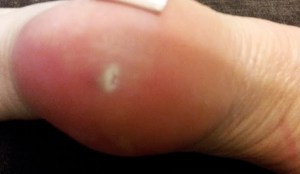
The other day I stepped on something sharp. I let out a small yelp, then checked my foot. I didn’t see anything much, so I continued with what I was doing – getting water for the guests in my living room. A while later, I was sitting on the couch with my feet pulled up next to me (my physical therapist wouldn’t like this, but I do find it comfy) and I happened to see something out of the corner of my eye. I looked again. Half of the bottom of my foot was covered in blood.

Of course, I did what any rational chronically ill person would do: I checked to make sure the blood hadn’t gotten on my dress. Priorities, people. Then I check the couch. When I was sure there was no blood on either, I hobbled to the bathroom. Then I hobbled back to the hallways for supplies, then back to the bathroom. I cleaned up the blood and covered the wound. Easy.

Then I came back and looked around. Everyplace I had walked when I was getting water had little bloody spots on the floor. Oops. I got a damp paper towel. I realized I couldn’t bend over, so I got down on my hands and knees. It wasn’t ideal, but I managed. To mean, this was the worst part.

My friend was trying to figure this out. She asked how it was possible to have that much blood and not feel it. Didn’t it hurt? I tried to explain that after more than 20 years of pain, I just stopped paying attention to pain. It’s not that it didn’t hurt, it’s that I didn’t care. I ignored it.

I know this is hard for someone without pain to understand. For me, it’s just how things work. If the pain is small enough that I can ignore it, then I do. That makes sense, right? Well, ok, maybe in this case I should have paid attention.

I won’t pretend I’ll always pay attention to injury-induced pain, but I’ll make an effort to at least make sure I’m not bleeding. I guess that’s a start. Because for most people, pain is our body’s way of telling us there’s a problem. I guess even for us folks with chronic pain, that’s occasionally the case too.

(Oh, and in case you’re wondering, I saw the doctor and there’s no infection. Thank goodness! Somehow I don’t think antibiotics would help my overall health situation right now. And the hole in my heel is closing up nicely.)