How little pain should I expect?

May 5, 2016

So many doctors have made it clear: I shouldn’t expect to ever live a life without pain again. Ok, I’ve accepted that. But lately I’ve wondered: should I raise the bar for my own pain relief expectations?

I’ve been watching friends, acquaintances and strangers online dealing with their chronic pain. They complain about their pain, while still trying to live somewhat normal lives. They complain that they can no longer go jogging, work two jobs, carry heavy loads, or climb a lot of stairs. At first I’ve thought, “well of course you’re in pain, you shouldn’t expect to still be able to do that.” But then I thought, maybe they should. Maybe I should.

Obviously there are limitations. I’ll never be able to jog. Or work two jobs. Or for that matter, carry heavy loads or climb a lot of stairs, either. But maybe I should be able to do more than I’m doing now without feeling so much pain.

Some days it isn’t that bad. It’s nothing more than a nuisance. But then, I never try to do anything pain-inducing anymore. I don’t think about it. I simply haven’t done those things for so many years that it never crosses my mind to pick up something heavy, reach out my arm at a certain angle, or sit still for a long time. I shift my position constantly without realizing it, because over the years I learned it was necessary and I did it so often that it became automatic. But maybe I should be able to sit still for longer without feeling pain?

There aren’t a lot of options. I don’t like using prescription painkillers because they upset my stomach and it doesn’t seem worth it. I’ve tried NSAIDS, steroids, Plaquenil, Cymbalta…. it’s not like there are a lot of prescription options left. I try nonprescription things too, mostly through my naturopath.

But today I opened the door for a new possibility. I registered for medical marijuana. The United States is a funny place. I know a lot of you aren’t in the U.S. so basically, marijuana is illegal on a federal level, but some states have made it legal. That means that technically you could get in trouble for having it even in those states where it’s legal, but chances are the feds won’t bother you unless you’re a big player of some sort. On top of that, our current federal government has specifically said they’d lay off. It’ll be interesting to see what happens after the next election. But I digress….

As I was saying, I registered for medical marijuana today. I paid $200 to see a doctor, because none of the doctors who do this are covered under insurance. In a few weeks I should have my license from the state. Then I can buy medical marijuana, also called cannabis, but going to a dispensary (there are about a half dozen in the state so far.) I learned about the different strains. It’s possible to get strains of cannabis that help the pain, nausea, or other symptoms without getting you high. That’s what I’ll be aiming for.

But what’s my goal? When I walked in the door today thinking that I wanted to use it for the days when the pain is the worst. The thing is, the people I spoke to there acted like I’d be using it more often to help the pain more often. After all, hadn’t I just said that I was in pain all the time?

I have no intention of using it all the time, of course. But maybe I could use it more, so that instead of only using it on the worst days, I use it on all be the best days. Because shouldn’t my goal be to feel as little pain as possible?

Obviously I have to wait and see how I feel once I start. Maybe I’ll want to use a lot of it, maybe not. I’ve used it before, so I know that I’ll at least want to use it for nausea and digestive pain. It’s a miracle for that. But what about my joints? If it helps my joints, should I try it? And I learned today that it can help fatigue. That could be a life-changer!

I don’t expect this to cure me. I don’t expect to be pain-free. I don’t expect to walk 5 miles or lift a 5-year-old. But maybe taking a swim and cooking dinner the same day should be a reasonable thing to expect?

How do you set your expectations? Our abilities and symptoms are all so different, but we all have the same problem of figuring out what limitations are reasonable and what aren’t. How do you figure it out? Please comment and let me know!


My calendar says I’m recovering that day

April 19, 2016

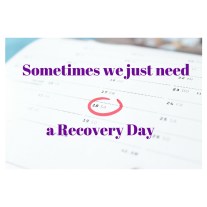
I used to call them do-nothing days. Or resting days. Or dead days. Lately I’ve been calling them Recovery Days. Because that’s what they are. I’m not doing nothing, I’m recovering!Recovery Day

Our culture says that a day of watching tv when you should be buying groceries and cleaning and going to a job and and and…. is lazy. I say that if you have a chronic illness, sometimes it’s necessary.

I had a recovery day yesterday. I could have pushed myself. I had a long list of things to do. If I’d pushed myself I might have been able to get a couple of things done. But I wouldn’t have gotten far on that list, and I would have done things badly. Then I’d have felt lousy today and I’d have barely gotten anything done at all. Sound familiar?

I used to push myself. At the time it seemed like a good idea. Now I know that pushing myself too much just means I’ll eventually hit the wall and I won’t be able to do anything at all.

So instead I took a Recovery Day. I didn’t leave the apartment. I read. I watched tv. I heated up leftovers for meals. That was it.

And today I felt better! I was able to go out and run errands. I’m sitting in a chair and writing this now (not an easy thing!) For me, that’s a super productive day.

Sometimes my Recovery Days are predictable. I can look at my calendar right now and tell you that I’ll be taking a Recovery Day on Sunday, so that’s blocked out on my calendar. I knew I’d probably be taking one yesterday, too, but I wasn’t completely sure until around 10am. I could just feel it, and there was no doubt it’s what I needed.

I used to take Recovery Days 3-5 days per week. If I left the house for an hour, the next day would be a Recovery Day. These days I’m feeling better and I only need them 1-2 times per week – yay! Of course, even now I have bad weeks, too. Sometimes a Recovery Day means spending all day in pajamas and doing nothing but watching tv. Sometimes it’s multiple days of that. Yesterday I felt better and was able to read a novel for a while. All that really matters, though, is that I gave my body the rest that it needed, in the form that it needed.

I know I’m lucky. I don’t have children or anyone else to take care of. I’m not working (though that’s not exactly a good thing.) So I’m able to spend an entire day indoors. I’m able to rest when I need to. But there are other things I should do on my Recovery Days that I can’t. I accommodate myself the best that I can. That’s all any of us can do.

You might have noticed that I’ve been capitalizing Recovery Day. That’s because it’s IMPORTANT! I think we don’t give ourselves enough credit for how hard these days are. We let culture pressure us into thinking we’re not doing enough when in reality we’re doing so much. Sometimes, it’s all we can do to get through these days. I’d rather go to the gym for 4 hours than need some of these Recovery Days. But I don’t have a choice, and I accept that (but it took me many years to finally accept it.)

How do you feel about your Recovery Days? Are you willing to rest when your body needs it? What do you do? How do you handle it? Please let me know in the comments so we can learn from each other!


Physical vs. cognitive: it’s all connected, sometimes

April 10, 2016

I was chatting with a few people about my chronic illness writing when one mentioned a friend with fibromyalgia who also has some cognitive issues. She asked if chronic pain and cognitive problems could be related.

Oh boy, here we go!

Someone else there with chronic pain said that it makes sense to have cognitive issues because the pain can be tiring, but she was a bit vague. I wanted to go deeper.

First, I pointed out that pain can be distracting. I asked, “If I stabbed you with a knife, how well do you think you’d complete a crossword puzzle.” I saw the wheels turning as the others processed that, imagined it. It was graphic, and it got my point across well.

Then, we mentioned how tiring it is to always be in pain. And on top of that kind of tiredness, it’s hard to sleep when you’re in pain, so there’s sleep deprivation, too. I asked how their cognitive abilities are after a few nights of bad sleep. “Now imagine that every night for decades.” Again, they slowly realized.

Finally, I explained how sometimes that thing that causes the pain and also cause cognitive impairs all on its own. In other words, the pain doesn’t cause cognitive problems, the cause of the pain causes those problems. For example, I have Hashimoto’s Disease. Hashimoto’s can have a lot of symptoms including joint pain, digestive issues, cognitive problems, low body temperature, weight gain, hair loss, and more. Notice that one of those symptoms is joint pain. Notice that another of those symptoms is cognitive impairment. Neither causes the other; they’re both caused by Hashimoto’s. Everyone nodded along.

I love that this acquaintance asked these questions and that everyone in the room made the effort to thoughtfully consider what I said. I love that they really tried to understand! Sometimes I hate talking about chronic illness because I just want to forget about it and go have a good time. But sometimes it’s so wonderful to educate people, to help them understand. And now the person who asked will have a slightly better understanding of her friend’s symptoms.

I admit, there are days when I dodge these questions, but today was a good day, so I answered, and I feel great about it. What about you? Do you ever answer these kinds of questions? Do you avoid them? Are you never asked? How do you feel about educating people? Please comment with your thoughts!


When the government forces pain upon us

March 17, 2016

This week there was a difficult statement from the Centers for Disease Control. Well, difficult for people with chronic pain and their doctors.

There has been a lot of discussion around the use of opioids for treating chronic pain. It paints all users are addicts. It suggests that the deaths caused from addiction negate any benefit that might be gained from proper use of the meds. It suggests that there is no such thing as proper use. And so on.

For the record, I do not use opioids. I have tried them and have always found that they helped me very little and that their side effects were terrible. If they worked for me and didn’t have bad side effects then yes, I would use them every day if that meant living with less pain.

Also for the record, many close friends take opioids daily. They are not addicts. They take their medications responsibly. These medications allow them to do heroic tasks like shower, cook, and drive to medical appointments. Occasionally they can even do something fun, like have me over for a visit.

This week the CDC issued a guideline. This is non-binding, but it does usually have an effect on doctors’ practices. I won’t get into the details here, but they’re linked at the bottom of the article below. Suffice it to say, a bunch of people who don’t have chronic pain have decided that those with chronic pain don’t need opioids. Apparently Tylenol and Advil should be sufficient. In other words, they’re completely clueless.

I find this whole thing very upsetting. So on the one hand, I think it’s incredibly important to talk about it. On the other hand, I don’t feel qualified to properly and fully discuss it, and I find it upsetting to even try.

Here are just a few of my thoughts:

  • Lumping together all opioid deaths, including those from heroin use, is hurtful, hateful, and absurd.
  • How can they not be accounting for the increased suicide rate that will result from this? Do they not care, or do they not understand?
  • Do they really think people would take medications with terrible side effects if Tylenol and Advil (which aren’t harmless, by the way!) really worked?
  • Do they have any idea how many different things pain patients try? Do they know how many more things we would try if insurance covered them? I have such a list of things I would do if I only had the money and the energy!
  • Have they not considered that maybe, just maybe, limiting the use of legal drugs will lead to an increase in the use of illegal drugs?
  • If the concern is addition, why not work to prevent and treat addiction? Studies have made it clear that this won’t help.
  • Where is the compassion?

I want to say so much, but I don’t have the words. So here are some reactions I want to share. At the bottom of that article is a link to the CDC guidelines.

The chronic pain community put up a good fight and lost this round. But the fight isn’t over. I don’t know what will happen next, but I know that no one will be giving up!