Disappointing others with a lack of answers

November 18, 2013

“How are you feeling?”

“Is the new treatment working?”

“When do you think you’ll feel better?”

My guess is we’ve all heard at least one of these, or something like them. I’ve been hearing them more and more, and I’m getting increasingly frustrated at having to answer these questions. I appreciate that people care. And there’s nothing wrong with the questions. When I tell friends and family that I’m starting a new treatment, I think it’s great that they’re thinking of me and wanting to know how it’s going. The problem is the expectations behind the questions.

Let’s face it, “Is the new treatment working?” is really asking if I’m feeling better yet, because they want me to be better. I’m glad they want me to be better, but it’s not that simple. And how do I say that I feel 10% better but not 100% better? It’s so hard to explain that. “Health” people are used to getting sick, taking an antibiotic, and being well. They don’t understand decades of illness followed by medications that do nothing or very little. They don’t understand that when a treatment “works” it may not be a cure. It may not get rid of the problem. It may just improve things a bit.

Every time I get those questions I want to be able to tell the asker that I’m doing great, I’m feeling better, the treatment is working, I’ll be healthy any day now. But that’s just not how it works. That’s not how my life works. So I disappoint them with the truth. What else can I do?


What to bring to your next medical appointment

October 30, 2013

I have seen way too many doctors in my life. Hell, I’ve seen way too many doctors this year. The point is, I’ve had some practice with medical appointments and I’ve learned a few things along the way. I didn’t think too much of this until I met with my potential new primary care physician on Monday. Twice during the appointment he commented that he wished all of his patients would bring in what I was then handing him. That reminded me that a lot of people don’t know to do these things. So I’m spreading my knowledge. Please share yours in the comments!

Here’s what I bring:

  • Forethought. I think in advance about what I want to get out of this particular appointment. What do I want to learn? What do I want to come away with?
  • Paper and pen, a laptop, or some other means of taking notes. It’s nice to think I’ll remember everything when I leave an appointment but I won’t. There’s just too much new information. By the way, don’t be afraid to ask the doctor how to spell the name of a possible illness or medication. It’s important to get it right so you can look it up later.
  • My list of diagnoses, especially for a new doctor. I have so many diagnoses at this point that I can’t remember them all. Bringing a written list is helpful. You might want to add other relevant notes, such as the year you were diagnosed with each one and how the diagnosis was made.
  • My list of symptoms. Same as above, it’s hard to remember them all.
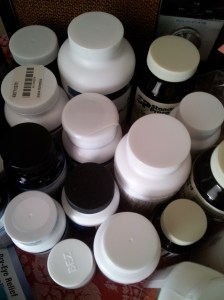
  • All of my medicine bottles, both prescription and over-the-counter. This way when a doctor asks how many IU of Vitamin D I take, or how much selenium is in my multivitamin, or a what an unknown item contains, I can just hand her or him the bottle to get the answer. After all, saying I take three calcium pills per day doesn’t mean anything unless I know how much calcium is in each pill. Sometimes I leave home the less necessary ones if my bag is too heavy for me to carry comfortably. There are a lot of bottles.
  • A list of questions. It’s nice to think I’ll remember to ask my doctor all of my questions, but when the time comes and I’m busy answering theirs, it’s easy to forget one. I start thinking about this list days in advance of most appointments and I make sure to write down absolutely everything I want to cover.
  • A list of tests I want run. This isn’t necessary for every appointment, but it’s important for many. In this case, the doctor planned to run some of the tests I wanted anyway, but there were several that he hadn’t planned on. When we discussed it, he agreed to run them. It’s a good thing I asked!
  • A list of referrals I need. This is especially important if your health insurance requires referrals in order to cover the expenses of care. Mine does. I brought the list so I’d be sure not to forget anyone.
  • Someone to lend support, ask questions, and later lend insight. I don’t do this for most appointments, but sometimes it’s necessary. I didn’t do it for this last one, but I’ve brought my parents to other appointments. I have also accompanied loved ones to appointments. The doctor never bats an eye – this is normal. And it’s so important.
  • A printout of all labwork from outside their hospital system. Within a given hospital system around here, doctors can see each other’s notes and test results. They can’t see these when they’re from other systems. Since I am seeing doctors in different hospital systems right now, I have to be careful to coordinate everything. Earlier this year I began recording all test results in a spreadsheet. Before Monday’s appointment, I filtered it to show only the labwork run by doctors in other systems and I printed that. My new PCP was thrilled. It included “normal” ranges, the date of the test, and the doctor that ordered the test. However, before I had this spreadsheet I would bring any copies I had of test results with me. If I needed to keep those pages, I would offer to let the doctor photocopy them.
  • Food and water. Some appointments last a long time. It’s good to have a snack for afterwards.

So that’s mainly what I bring. Obviously everyone’s needs are different, but this might be a useful starting point for many people. In case you’re wondering, the two things that made my new doctor especially happy were the pill bottles I’d brought and also my printout of labwork. What do you bring with you to medical appointments?


The one thing I really miss about gluten

October 22, 2013

People ask me all the time if it’s been hard to give up gluten, or what I miss, or how I do it. Even though I used to wonder the same thing about others back before I’d done it, now I find these questions so strange. It’s not hard, because I feel so much better. There’s no question of how I do it, because I feel so much better; willpower isn’t 20131022_204902necessary because there’s no temptation. There’s one thing I really miss, but it’s not what most people think.

I don’t miss the gluten-filled pastas or breads at all. I don’t miss the cookies or cakes, either. Don’t get me wrong, I love all of these things. It’s just that the gluten-free versions are just as good, and I’ve realized that having them less often is fine. In fact, I now only have sweet desserts about once a month, and that’s plenty for me. I stopped eating pizza many years ago because it made me sick, so I don’t miss that. Gluten-free soy sauce is just as good for cooking as the gluten kind. Gluten-free chicken broth tastes as good to me as the gluten type. I know it’s not easy for everyone to find substitutes, and I’m glad that I have these options. I can’t substitute everything easily, of course, but for the most part I don’t care. Some things I have just stopped eating altogether, and I don’t mind. I don’t miss them. And there are plenty of foods that are naturally gluten-free, too. The truth is, my diet is better now, and I’m happy about that.

There’s one thing I miss a lot, though: convenience. I miss being able to leave my house without thinking about what I’ll be able to eat while I’m out and if I need to bring food. I miss being able to go to a friend’s house for dinner without having to bring my own meal. I miss running errands without packing snacks. I miss being out longer than I expected without worrying about what I’ll eat. I miss grabbing a cider donut with my friends while we’re apple picking. I hear that the gluten-free bakery has them but now, weeks later, it’s just not the same. I miss eating Chinese food in Chinatown; now I can only go to certain restaurants that have gluten-free items. Mostly, I miss not having to worry about it what, when, or where I’ll eat.

But I don’t miss feeling sick every single day and that makes the inconvenience completely worthwhile. I do not have any desire to “cheat” on my gluten-free diet and I doubt I ever will. The benefits are just too great to give it up for a bit of cookie.


Should I try to trust doctors?

October 10, 2013

I’m in a bit of medical flux at the moment.

I have a naturopath who’s very helpful and knowledgeable, but thanks to absurd politics, naturopaths aren’t licensed in Massachusetts. That means she can’t order blood tests or prescribe medications. Great. I haven’t had a primary care physician (PCP) that I’ve trusted in many years, and in hindsight, none of them were very good anyway, and some even did harm. I have never had a “good” PCP. I have some specialists who are good, but they aren’t in the specialty that I need right now. In a few weeks I’ll see a new PCP, but I’ve never gotten any value out of PCPs. Still, they are necessary for insurance referrals, so I will see the PCP and grade him based on his willingness and ability to refer me to good specialists. And when he does refer me, should I trust the new specialist?

After many years of bad health, I’m finally ready to try new treatments that could really help me. But these are all based on research that I did myself. I then ran that research by my doctors and naturopath and they all agree this is the way to go, but I had to figure it out for myself. I no longer expect a doctor to give me any answers. That means that right now, I am only looking for doctors who are willing and knowledgeable enough to implement the treatment plan that I have designed for myself, and to help catch any potential problems and fix them.

The thing is, what if something new comes up that I haven’t already researched? I just can’t trust a doctor to catch it and treat it properly. It could be big or small, but I won’t trust them. I know that trust is essential, but I just don’t have it for most in the medical field. I have seen my naturopath quite a bit in the last year+ and I mostly trust her, but not 100%  So then why would I trust someone new?

I don’t trust easily. That goes for friends, lovers, medical practitioners, and anyone else I get close to. I don’t give out trust; it has to be earned. My friends have all earned my trust. If they hadn’t, I wouldn’t consider them friends. So have my lovers. If they hadn’t, I wouldn’t have slept with them. But I don’t have the luxury of visiting doctors a bunch of times and letting them earn my trust. Most of them don’t seem interested in earning it, and the insurance won’t pay for it (nor will my bank account.)

The truth is, I have been screwed over by doctors, health insurances, and medical facilities so many more times than I have covered in this blog. Tests I needed weren’t run. Abnormal test results were ignored. Surgery was performed unnecessarily. I was blamed for my own health problems. I was ignored. I was embarrassed. I was belittled. I was outright lied to. Necessary referrals to specialists weren’t given. Important medications were denied. It’s not that I won’t write about it all, it’s that I can’t. I can’t even remember it all. There’s just too much.

So after all of that, how can I be expected to trust a new doctor? But then, what other choice do I have?

By the way, I set out to write about what I am looking for in my new doctors. I need to think about this before I see them in a few weeks so I really tried to come up with what was most important to me. I couldn’t come up with a damn thing because no matter how I thought about it, it always came back to the same problem: I wouldn’t trust them to help me.