When healthcare talk is traumatizing

August 24, 2014

I’ve been noticing a disturbing trend and I’m not sure what to do about it. It’s been brewing for a while, but a couple of conversations recently made me realize how problematic it’s become.

Embed from Getty Images

First there was the conversation with a volunteer for one of the gubernatorial candidates. We were in a social situation, but when I asked about her volunteer work, the conversation turned to that. She started talking about his plan to make our state a single-payer healthcare system. I wanted to calmly explain why I didn’t think this would work. I remained mostly (but not entirely) calm on the outside, but on the inside I was boiling, thinking about the many injustices I have faced within the system and how the government certainly didn’t make it any better.

The second conversation was a few hours ago. A half dozen of us were hanging out after lunch, chatting. Then one woman asked us if we’d ever faced discrimination in healthcare due to our sexual orientation (we’re all bisexual.) This isn’t something I’ve experienced, so it was safe territory, right? But just hearing people talk about their experiences was very upsetting to me. It made me think about all of the similar experiences I’d faced that weren’t discriminatory, but were hurtful nonetheless. It made me want to share my own stories that were about healthcare, but that had nothing to do with biphobia. As they talked, I remembered incidents that I’d forgotten about. I thought about recent incidents that were still fresh.

And I got upset.

Again, I stayed mostly (but not entirely) calm on the outside, but inside I was simmering, ready to explode like a volcano. I wanted to yell, to cry, to ask for understanding, to plead for someone to help.

That’s not normal. It’s not healthy. I know it. But I don’t know what to do about it. I saw the warning signs of this many months ago and I starting looking for a therapist who had experience with chronic illness issues. But then I started having health insurance uncertainties, so I decided to hold off until they were settled. Well, they’re finally settled, but now I have a different problem. For personal reasons, I don’t want to see a therapist at one of the major hospitals. I would only see a private practice therapist. And private practice therapists generally don’t take medicare and medicaid for health insurance. And I can’t afford to pay out of pocket for someone.

The truth is, I probably should have been seeing a therapist before now anyway, but I’ve always managed to handle these things on my own. I tried therapy a few times and never got anything out of it. I’m pretty self aware, so I made do. But this is different. I don’t know how to handle the anger, frustration, fear, and desperation I feel whenever anyone talks about doctors, healthcare, or health insurance. Feeling these emotions about my own situation is bad enough, but I shouldn’t be feeling them whenever the topic is broached in a way that has nothing to do with me. I should be able to talk to a friend about their own medical condition without this kind of trigger response.

I just wish I knew how to make that happen.

What about you? Have you felt this way at all? Do you have trouble talking about other people’s medical issues? Do you know of any ways to get inexpensive mental health care in the U.S. or, even better, in Massachusetts? Please comment below and let me know about your experiences.


The what-ifs of old medical records

July 29, 2014

I suppose it’s only human nature to wonder if there was a chance I could have been diagnosed sooner. But when the test results from years ago are staring me in the face, I don’t have to wonder any more.

A couple years ago I began recording all of my lab test results in a spreadsheet. It’s something I’d wanted to do for years, and I finally did it. Now, I can easily sort or filter to see all of my tests from 2013, all of my TSH tests, all of my cholesterol 10-4-2012 10-59-49 AMresults, etc. Unfortuantely, I was only recording everything from the end of 2012 and forward.

Over the years, I’ve collected quite a pile of medical records. Each new envelope was added to my desk drawer. As I began to fill up a second drawer, I realized I needed to get back that prime space. I decided to box up all of my records and store the box away in a corner or a in closet.

Now that I have a spreadsheet of lab results, it feels wasteful to put records in a box without reviewing them first. So as I add each record to the box, I look at it. If there’s anything relevant (or at least, currently relevant to my untrained eye) then I add that to my spreadsheet. I’ve been recording lab results, but I’m also recording other useful information, like names of doctors. I’ve forgotten many of them over the years, and one day it might be useful to know which doctors I’ve seen. Almost as useful as knowing my old test results!

The first time I was diagnosed with an autoimmune condition was when I was 23. At that point, I’d had symptoms for 11 years. I was diagnosed based on a high ANA (anti-nuclear antibody) test. The doctor I saw wasn’t in the same network as all IMG_20140729_220919of the previous doctors, so the only records he had were the stack I handed him. He didn’t see anything on a computer or talk to anyone. That’s probably why he was able to start fresh. He ran the test. But when he looked back through my records, he saw two previous ANA tests that were high. They weren’t high enough for a diagnosis, but they were high enough that someone should have been keeping an eye on them. And yet no one ever mentioned it to me! So what else was missed?
As I’ve been looking at my records, it’s horrifying to see the many missed opportunities. But last night really got me. I was glancing at some test results from 2007, passing over the normal blood counts, mentally noting the high triglycerides (which I’d had for many years, so that was no surprise,) when I noticed two shocking test results.

The first shocking result was my TSH. It was tested 4 times in 2007. Each test was done at the same lab, with a normal range of 0.270-4.20. The normal range is different now, but that was what the lab used back then. My results were, in order: 4.890, < 0.014, 1.030, 3.860. Yikes! That second number was at a dangerously low level, but no one ever mentioned that to me. They probably adjusted my medication after the first test, which was high, and my TSH dropped too much. The second test was way too low, so they adjusted it again. The third test was done just a month after the second, so it was too soon to know anything. The last one was within the “normal” range, but for someone with hypothyroid it was too high. Given these results, it’s shocking I wasn’t even sicker than I already was! And it’s disturbing that over a year after being diagnosed as hypothyroid, my TSH was ever allowed to reach 4.890 to begin with.

The second shocking result was also shocking for the test itself. Apparently, back in 2007 I had a 24 hour urinary cortisol test done. I didn’t know! I wonder which indicators caused my doctor to run that test? I’m sure I have a record with her notes about that, but I’m not organized enough yet to know where it is. I bet it would be relevant, though. And of course even more relevant are the results! They would have been good to know in 2012 when I was out of work, feeling lousy, and dealing with a doctor who didn’t believe I had a cortisol issue. Because the thing is, even back in 2007 my cortisol was too low! It was 0.61, only slightly below the normal range of 0.63-2.50. Still, cortisol shouldn’t be at the lower end of the range, much less below it, and I had the symptoms of cortisol problems along with chronic pain and hypothyroid, which can both contribute to cortisol problems. And yet it wasn’t addressed. Or mentioned. At all. And so it was another 5 years before I found out I had adrenal insufficiency. By then, things had gotten worse. That’s obvious from both the test results and from how I felt.

Even if all of my health problems were caught earlier, I’d still have autoimmune conditions. I would always have Hashimoto’s Disease and hypothyroid. That wouldn’t have changed. But if I’d known then what I know now, if the doctors had addressed these issues back then, so much would have been different. The adrenal problems could have been addressed before they turned into adrenal insufficiency. The Hashimoto’s could have been addressed before so much of my thyroid was destroyed. I might never have suffered such debilitating fatigue. I might never have had to leave my job. I might not now be on Social Security and unable to work. I might not have gone through the stress, emotional upheaval, and bullying of navigating long term disability insurance, social security, and MassHealth. I might not have had the financial strain of the past several years.

And you know the worst part of all? Those “mights” are really “likely.” Because chances are, a lot of my small problems in 2007 could have been prevented from becoming big problems in 2014. And that is a personal tragedy. That is a failure of many doctors and of our medical system in general. And that is a harsh reminder that no one will ever care more about my health than I do, and so I must continue to do my own research, review all of my own test results, and question everything. The doctors might not like it but if they complain, I’ll just point out the dozens of mistakes that have already been made in my care. And if they still don’t like it, I’ll find others. Because my health is too damn important to allow these travesties to happen again.


What would you say is “real” about chronic illness?

July 10, 2014

I thought about starting this blog for a while before I actually did it. What finally pushed me to get started was one too many “inspirational” stories. You know the kind. Someone who had a leg amputated climbs a mountain and we should all be inspired blah blah blah. Now, I think it’s great that someone can do that. What bothers me is that it gives the impression that 7-10-2014 5-46-47 PMwe can all get over our disabilities if we just try hard enough. Yeah. That’s just not how it works.

I didn’t know how many others felt the same way, but I wanted to write about the reality for me. I wanted the people close to me to understand a bit more about how it really works. And at the same time, I wanted other people with disabilities and chronic illnesses to see that they weren’t the only ones suffering on the couch instead of climbing mountains. It turns out I wasn’t the only one who felt that way; my most-viewed and most-commented on articles are the ones about things we don’t usually discuss publicly, like pooping on a guy during sex, boob growth from Prednisone, feeling guilty about making others worry, the frustration of not knowing why I feel so crappy, the frustration of seeing doctors who won’t or can’t help. I bet you’re nodding along to at least one of these. And I bet at one time, or maybe even before you read this, you thought you were the only one who felt that way. I know I did. It’s sad how alone we can feel with these illnesses.

That’s one reason I love the idea of a bunch of people sharing stories all in one place. Blogging is great, but I think we all know it can be hard to follow multiple blogs. And when you don’t even know what’s wrong with you, how do you know which ones to follow? That was my problem for a long time (but with books, in the days before blogs came out.) Plus, maybe I’m old-school, but I love the idea of a book. So I don’t know about you, but I’m going to participate in this project for an anthology about chronic illnesses. The hard part will be deciding what to write about! There are so many possibilities to choose from!

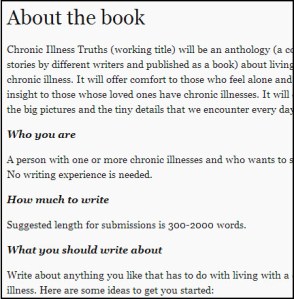
I don’t usually write posts about projects like this, but I also don’t usually participate in them. And this is also my way of helping out with a signal boost. Anthologies usually don’t get published unless there’s significant participation (dozens or even hundreds of articles submitted) and under “How you can help” she asks people to pass along the word about the project, so at least by writing this, I’m doing my part (plus I’ll post to Facebook and Twitter, too.) If you want to help spread the word, you can share the link to this blog post or to the project itself: http://chronicillnesstruths.tumblr.com/aboutthebook

If you’re thinking about writing, consider this line taken from the “How you can help” section at the end: ” If you want to see more voices like yours in books like these, here’s your chance!” That’s good enough for me!


All rainbowed up and no place to go

June 13, 2014

One thing about chronic illness is that I miss out on a lot of events. You name it, I’ve missed it: weddings, dinners out, birthday celebrations, medical appointments, support groups, parties…. Illness doesn’t discriminate. Sure, when there’s an especially important event, I’ll try to rest up in advance, but it’s not like I always have a choice.

This weekend, I’m wondering if I’ll be attending Pride events. For those who don’t know, LGBT Pride is the biggest holiday2014-06-13 17.03.12 of the year. It’s like queer Christmas, Chanukah, and birthdays all rolled into one. It’s something I look forward to for months. As I type, my fingernails are painted in rainbow colors. My buttons and mardi gras beads are ready. And I’ve been feeling crappy all week. Because my illness doesn’t care about Pride. It just acts up whenever it wants to.

Last year there was a hurricane coming up the coast and a bunch of us went out to the Dyke March anyway in the drenching rains. We got soaked, but we were glad we went. The next day was warm and sunny and the Parade was a ton of Rainfun. As usual, I was too tired to go to any of the parties at night or on Sunday, but that was ok, because I went to my top two choices: the Dyke March and the Pride Parade.

This year it’s raining again. It’s not as bad as last year, but it’s not exactly a light rain, either. Check out the view from my window. If I was having a good day, I’d just suck it up and go. But do I really want to do that when I’m already feeling so crappy? No, not really.

Tomorrow is supposed to be cool but with a very high dew point. Which means I may not feel up to going to the Pride Parade either. Plus, just to add in another obstacle, the closest subway station is under construction so I’d have to do even more walking. Oh yeah, and there’s a 50% chance of rain. Ugh.

So maybe I’ll just go to the party on Sunday. And that would be nice. But that’s not what I really want to do. I want to go to the March tonight and to the Parade tomorrow and I don’t want to have to wait another 12 months for my next chance. Plenty of people will skip out because of the weather and that’s their choice. But it wouldn’t be mine. I’ve gone out to both the March and the Parade in the rain before, and I want to do it again. I want it to be my choice, not my body’s. And that’s why I’m feeling so pissed off right now.