Sometimes ignoring pain is a bad idea

June 4, 2013

One thing chronic pain does is it teaches you to ignore pain. If I didn’t ignore pain, I’d have long ago stopped eating, sleeping, showering, dressing, laughing, having fun, having sex, walking, writing, and many other things. Instead, I learned to ignore most of the pain and I continued on with my life.

I’m not going to pretend that I don’t feel the pain. But let’s be honest, if you have chronic pain, do you really notice the minor Heelpain? When it’s a 2 on the pain scale, are you even aware of it?
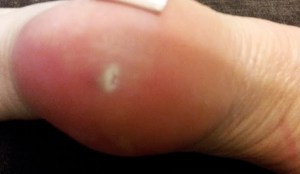
The other day I stepped on something sharp. I let out a small yelp, then checked my foot. I didn’t see anything much, so I continued with what I was doing – getting water for the guests in my living room. A while later, I was sitting on the couch with my feet pulled up next to me (my physical therapist wouldn’t like this, but I do find it comfy) and I happened to see something out of the corner of my eye. I looked again. Half of the bottom of my foot was covered in blood.

Of course, I did what any rational chronically ill person would do: I checked to make sure the blood hadn’t gotten on my dress. Priorities, people. Then I check the couch. When I was sure there was no blood on either, I hobbled to the bathroom. Then I hobbled back to the hallways for supplies, then back to the bathroom. I cleaned up the blood and covered the wound. Easy.

Then I came back and looked around. Everyplace I had walked when I was getting water had little bloody spots on the floor. Oops. I got a damp paper towel. I realized I couldn’t bend over, so I got down on my hands and knees. It wasn’t ideal, but I managed. To mean, this was the worst part.

My friend was trying to figure this out. She asked how it was possible to have that much blood and not feel it. Didn’t it hurt? I tried to explain that after more than 20 years of pain, I just stopped paying attention to pain. It’s not that it didn’t hurt, it’s that I didn’t care. I ignored it.

I know this is hard for someone without pain to understand. For me, it’s just how things work. If the pain is small enough that I can ignore it, then I do. That makes sense, right? Well, ok, maybe in this case I should have paid attention.

I won’t pretend I’ll always pay attention to injury-induced pain, but I’ll make an effort to at least make sure I’m not bleeding. I guess that’s a start. Because for most people, pain is our body’s way of telling us there’s a problem. I guess even for us folks with chronic pain, that’s occasionally the case too.

(Oh, and in case you’re wondering, I saw the doctor and there’s no infection. Thank goodness! Somehow I don’t think antibiotics would help my overall health situation right now. And the hole in my heel is closing up nicely.)


You deserve a good sex partner

May 19, 2013

Too often, people with chronic illnesses feel like we’re lucky to have whatever we get in life. We’re lucky to have a job, no matter how good or bad. We’re lucky to have a spouse, no matter how good or bad. We’re lucky to have friends, no matter how good or bad. But we deserve more than that. We deserve the best! And that’s true for sex partners, too.

I haven’t seen my sex buddy, D, in two very long weeks. There I was, feeling horny today, when I started to question whether I’m physically up to seeing him at all this week. After all, this recent downturn has been really bad, and every bit of activity makes it worse. I’ve written before about how sex can make me feel better, but is it worth trying? Then I remembered just how awesome D is, and I thought about how lucky I am. That made me realize that while I’m definitely lucky to have him in my life, and I shouldn’t take him for granted, I also should never settle for anything less. And neither should you.

Somehow, D has never been phased by my health stuff. I mean, I once crapped on him during sex and he just brushed it off and suggested we clean up together in the shower. Pretty awesome, right? Here are some other ways he’s completely wonderful about my health issues:

  • When I feel especially bad, he does all the work, and never complains.
  • When I’m in pain, he’s extra gentle.
  • He’s careful about avoiding touching areas that he knows are extra sensitive, like my wrists and feet.
  • He’s significantly larger than me and is always careful not to let his extra weight put too much pressure on any part of me that could hurt.
  • We both like sex just a little rough, and when he pins me down, he’s careful to avoid areas that he knows are a problem. He’ll pin my forearms instead of my wrists, for example.
  • When I wince, he always sees it and immediately asks how he can adjust things.
  • When something is clearly difficult for me, he doesn’t push it. For example, last month he was lying on top of me and tried to pull my head/neck up to kiss him. Clearly my body was having none of it, so he just changed positions so I could stay flat on the bed.
  • He respects my illness-related fears. Even if something doesn’t hurt, I might be scared that it will, so he avoids it.
  • He pays attention to good hurt vs. bad hurt and respects both. Good hurt was when he was sucking on my breast and I responded with “Ow! That feels good!” and he kept going. Bad hurt was when I yelped and winced and yelled, “Ow!” and he immediately stopped and asked what was wrong and what he could do differently.
  • When I need to switch positions at an inopportune time, he doesn’t say a word about it.

See what I mean? He’s awesome. Of course, it’s not all him. I have to do my part too.

I have to listen to my body and respect what it wants. I was young when the pain started, so I’ve never had sex without pain. That also means I’ve had a long time to learn how to adjust things. I may not be able to practice all of the techniques or positions I’ve read about, but I have found quite a few popular ones that I can do without pain. I am careful to pace myself. For example, I know that when I give a hand job, I can only go for so long with each hand before the pain gets too bad, so I’m careful to switch before I reach that point, and I always time the switch to be the least disruptive to him. I also position my body to have the right leverage for my arm without straining my neck. I pay attention to what works for him, and I find ways to improve on it that he enjoys and that don’t hurt me. And when pain does sneak in, I make an effort to not let it disrupt things. Like a few weeks ago, when I was just starting to orgasm, and it felt so good, and my body tensed up, and my toes curled, and… OH MY GOD! THAT HURTS!  But I didn’t lose it. I relaxed my feet and uncurled my toes and felt the pain go away just enough, and I kept my head where it needed to be – in the orgasm. I could have let that spear of pain interrupt things, but I didn’t. Obviously that doesn’t work when the pain is at its worst, but so many times I’ve been able to ignore it or use it. And it’s always worth it! Of course, the most important thing I do for myself is communicating. I think that communication is always important during sex, but it’s extra important if you’re dealing with pain and other chronic issues. Tell your partner what’s likely to cause problems in advance, and stop him/her if there are problems in the middle. They won’t mind. And if they do, they don’t deserve you.

So you need to do your part too. You need to make sure you’re doing the best you can for your body. Communicate and respect your own needs. And make sure it’s not all about you – do nice things for your partner, too. Most of all, don’t put up with anyone who isn’t kind, respectful, and understanding. You deserve all of those things, and don’t let anyone tell you otherwise. We’re sick. We have health problems. Fine. But we are still fine human beings to deserve to be treated as well as everyone else.


Taking pills 10 times a day, literally

May 17, 2013

I wrote once about how much time I spend on health stuff. I wrote about lawyers and insurance and doctors… those are the things that you’d expect to be both time consuming and mentally consuming. As I was trying to work out a new pill schedule the other day, it occurred to me that most people probably have no idea just how time consuming, not to mention mentally consuming, it can be to take pills!

A “healthy” person might not take any pills. Or they swallow an occasional multivitamin or birth control pill. I’ve been trying to remember when I last had a day without pills and my guess is that it was probably around 1996 or so. Then for years my pills were simple: a birth control pill, then a BCP and a thyroid pill, then a BCP and the thyroid one and a multivitamin…. and then it got worse.

I miss the days of simply taking a pill or two with meals. Now, everything has to be timed out so carefully. There are the pills that must be taken with food. There are the pills that must be taken away from food. There are pills that must be taken away from each other. There are pills that need to be taken at specific times of day.

Oh, and when I say “pills,” that includes liquid meds as well.

It’s taken a lot of mental energy and help from my naturopath, but I finally have a working schedule (until the next addition or subtraction, that is):

  • 8am: thyroid pill – 1 pill
  • 8:30: adrenal support, dhea – 5 pills
  • after breakfast: a whole bunch – 9 pills and 8 sets of drops, and a cream
  • 2 hours after breakfast: fiber – 2 pills
  • after lunch: another bunch – 5 pills and 7 sets of drops
  • 2pm: adrenal support, dhea, calcium – 4 pills
  • 4pm: fiber – 2 pills
  • before dinner: calcium – 1 pill
  • after dinner: another bunch – 7 pills and 8 sets of drops
  • 9pm: bedtime stuff – 4 pills

Wow, this looks even worse written out than it did in my head. Actually, the original title for this post had “9 times a day” written, because that’s how I’d counted it. Then as I wrote it out, I realized I’d missed one. It’s a lot to keep track of. The thyroid pill has to be an hour before meals. The adrenal support has to be 15 minutes before eating and at specific times of day. The fiber has to be 2 hours after and 1/2 hour before eating. Some of the mealtime pills are taken then because they have to be taken with food. The multivitamin has extra iron, and the iron and calcium have to be taken at least 1/2 hour apart. In fact, I should be taking calcium 3 times per day but I’m only taking it 2 times per day because I can’t figure out where else to squeeze it in! The drops don’t have to be taken at specific times, but they’re hard to carry around, so I need to take them at home. That means that sometimes I only take them 2 times per day, but that’s ok, as long as I at least take the drops for vitamin D. Some of the pills, though, can’t be missed. Like, they really, seriously, can’t be missed. Like, if it’s really late and I don’t want to deal with driving and so my parents say I can just stay the night, I can’t. Because I have to get home. I have to get home to where the pills are. Because I really can’t skip those morning pills, or even take them late. Some don’t seem too important, but they are. I tried cutting the fiber back to 2 times per day instead of 3 and the effects were horrendous. I’m not about to try that again any time soon!

So you may be wondering what my point is? I have three points:

  1. For those who are in a similar situation, you’re not alone. I get it. Lots of us get it.
  2. For those who complain when they have to take a single pill for a cold, or even for something daily, tell it to someone else. I don’t want to listen.
  3. If you think that by not working I just sit around all day and have fun, and you haven’t figured out yet that that’s not how it works, just imagine trying to keep track of all of this. Imagine how long it takes me to fill my pill boxes each week. And since the drops can’t be prepared in batch in advance, I have to deal with those three times, every single day. Trust me, it would be easier to work a job.

And on that note, I’m off to get some sleep. I hope. Because there’s no more sleeping in for me – I have to be up early to take those pills!


You put orange juice in this?!?

May 13, 2013

I appreciate when people try to accommodate my food restrictions. They go out of their way to make sure I can eat their food, and it means a lot.

Unfortunately, some people don’t take it as seriously as they need to.

Here’s the thing: some allergies kill, some don’t. But all allergens need to be avoided.

So sure, eating beets or peanuts won’t kill me. But I’ll be pretty damn miserable for a week or more. I could have increased pain and increased fatigue, and I’ll definitely have all sorts of horrible digestive problems. So even though I’ll survive, that’s still some pretty rotten stuff that I’d rather avoid.

I’ve done pretty well in restaurants. I don’t go out to eat often and when I do, I make sure the waiter really understands my needs. So far, so good. Unfortunately, eating the food that friends and relatives prepare hasn’t gone as well. In fact, I’ve gotten sick several times. There have also been a few near misses.

A good example of a near miss was this weekend. We were having a lovely family meal. B had gone to great effort to prepare everything. He told me all of the ingredients, to be sure I could eat it. It all sounded fine except for one sauce, which he kept separate. I was thrilled. Later, as he was getting it all ready, I asked him again about the ingredients. Again, it sounded fine. Then while we were eating, someone else asked how he made it so they could copy it themselves. He ran through the preparation, and then mentioned what made it so great – the orange juice used at the end. Wait a minute, he didn’t tell me about any orange juice! I froze with food on a fork halfway to my mouth. I must have said something, because everyone looked at me. I’d already eaten several bites. Oh crap. He shook it off with, “It’s only orange juice.” I was horrified! As it turns out, it was a freshly squeezed orange, so I was ok. Store-bought orange juice would have been a problem. But he didn’t know that. He just assumed it was fine for some crazy reason. Or maybe he’d forgotten it earlier and he was trying to cover his tracks. Either way, I was really insulted. Here I thought he cared enough to work around my food allergies, and he’d left out an entire ingredient that didn’t seem important to him. This is the second time he’s done this. Once could have been a fluke, but twice is the start of a pattern that I don’t want to continue. I know he’ll be insulted when I don’t eat his food anymore, but my health is more important then his feelings.

I think that’s the important thing that so many people don’t seem to understand. My health is more important than their feelings. So if they suddenly realize they’ve forgotten to tell me about an ingredient, I’d rather they just say it than to wait and hope it’s ok. That’s happened with others who’ve cooked food that I’ve eaten. And it’s not ok. And if I say I can’t eat it, that’s not a comment on your cooking ability. It’s that I’d rather not spend the night doubled over in pain because I chose to eat something with a peanut sauce in order to keep you happy. Why is this so hard to understand?

Some of these incidents have turned out badly. I’m just thankful this last one was ok. I’m in the middle (or hopefully beyond the middle) of a bad downturn, and it’s kicking my ass. I’m pretty sure that eating the wrong foods right now would be a very, very bad move. Which is why for a while at least, I won’t be eating anyone else’s cooking.
