Why I’m against the way we dispense the birth control pill

July 31, 2013

I was put on “the Pill” the week I turned 18. I wasn’t put on it for birth control purposes, but because my previously-heavy period had gotten so bad that I passed out from the loss of blood. The doctors figured this would fix that problem.
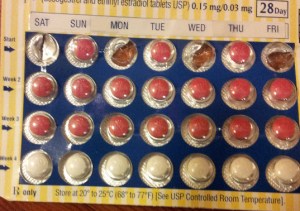
Birth control pills

What it did was mask the problem. Once I was on birth control pills (BCPs), I could no longer have accurate hormone tests run. The specialist thought I had PCOS (polycystic ovary syndrome) but it would be another 7 years before I found out he was right. In the meantime, I just dutifully took the Pill every day, as instructed, and assumed I wouldn’t get pregnant and that everything was under control. My primary care physician (PCP) du jour always prescribed it.

A friend of mine was suffering from depression for a long time. She tried changing all sorts of things about her life. She got a new job, tried a new diet, saw therapists, but was still depressed. I saw her a few months ago and the transformation was incredible! She was the happy, upbeat person I remembered from so many years ago! She was dealing with some truly horrible circumstances at home, and yet she seemed happier than I had seen her in 10 years. What changed? She went off the Pill. She said the change happened quickly. She’s no longer in therapy. She’s just avoiding birth control pills. Too bad none of her doctors thought to try that. Apparently, it never occurred to any of them.

A friend of mine found out the hard way that because of a medical condition, birth control pills won’t prevent pregnancy for her. She found when she got pregnant!

I now take a half of a BCP every day. I do this not for birth control, but because I need the boost in my estrogen levels. This is how my endocrinologist prescribes it.

Hormones are a tricky thing. Mess them up, and you could be in serious trouble. I know this from experience and from what I’ve witnessed. So why are PCPs prescribing hormones? Why aren’t women being sent to endocrinologists? Now there’s even talk about making BCPs available over the counter, without prescription!

Let me be clear. I am very much FOR giving women better birth control options. I think that making BCPs widely available is a good thing, but it needs to be done intelligently. Women should receive free visits with endocrinologists. Only endos should be allowed to prescribe BCPs. Endos should be well-versed in the possible side-effects of BCPs. When I got horrible mood swings once a month, when I felt horribly depressed and wanted to cry for no reason, my endo knew to take me off the Pill, let my body settle down, then start me on something else. My PCP didn’t know to do that. After women get these free visits, then BCPs should be available at the local pharmacy free of charge. I strongly believe this.

On the other hand, I do not want to see women getting the Pill without seeing a doctor. This is an unpopular view among my very liberal social crowd, but having more experience with medical issues, I am very ready to confidently take this stand. There are just too many ways it could go wrong. There are women for whom BCPs won’t work as effective birth control, and many for whom it can have horrible side effects. We call it “the Pill” and yet there are many different formulas. Should I take an estrogen-based one or a progesterone-based one? I like the idea of only getting my period 4 times per year, but will that one work for me? I could ask the pharmacist, but what will they know? They have no idea what my hormone levels are. No, women need to see endocrinologists who know which tests to run, how to interpret them, which medications to prescribe, and how to handle the side effects.

Our bodies are too important to just hope that it all works out.

And by the way, if providing free birth control is so important, where are the free condoms? I don’t want to get pregnant, but BCPs won’t work for me, so I need something else (assuming I’m even fertile, but that’s a topic for another day.) Plus, I don’t want to get STIs, either! Condoms should be distributed at doctors’ offices and at pharmacies, free of charge. Those things are expensive! Let’s make it easier for everyone to avoid unwanted pregnancies and STIs.


Energy work-arounds for a social life

July 26, 2013

Yesterday I had some friends over to my place. We all have chronic health issues, so we all understand how hard it is to do these get-togethers. Beforehand, talking on the phone, S mentioned how great it is that I had the energy to organize this. I pointed out that all I did to “organize” was send a few emails, and that by having it at my place, I didn’t need to expend the energy to go anywhere. See, she and the others thought I was being generous by offering to host, but really, I was saving up my energy by having them here. She laughed and appreciated my “sneakiness.”

Of course, this only works to a certain extent. I was still running around, opening and closing windows to adjust the temperature, getting food and water for people, cleaning up spilled food (I do love my dustbuster!) and generally trying to be a good hostess. By the end I was exhausted, despite having rested most of the previous day, and so I spent all day today in my apartment resting. It has only been in the last hour that I have begun to feel a bit less run down.

I was also resting today because I am going out tomorrow. Because of the weather, I wanted to be indoors. The friend I’m going out with suggested a few possibilities. I chose a small museum for which I can gain free admission through an old job perk. She’s thrilled to go, and I can save both money and energy. I’ve been there many times, so I know that it’s easy to navigate with lots of comfortable seating throughout the place, a great elevator, and small manageable rooms. Luckily, they change exhibits often, so it’ll still feel like a new experience for me. My friend is driving, so that saves me energy too. And with my handicapped parking placard, we should (I hope!) be able to park close to the entrance. She will buy food at the cafeteria and I will bring my own so that we can eat together there.

I have no plans for the following day, so if I’m tired then I’ll just stay home and rest.

This isn’t perfect, and I’m far from my energy goals, but it’s a start. By resting, hosting, and planning shorter activities, I can at least have a bit of a social life. It may not be the social life I used to have or the one I want to have, but I’m still incredibly grateful for every bit of it.

How do you manage your energy limitations? What do you do to maintain a social life? Please share any ideas you have!


The myth of a miracle cure

July 21, 2013

Warning: This is a bit negative, even for me, so make sure you’re feeling positive and upbeat before you read it. And afterwards, go look at pictures of cute puppies or something. A picture of my favorite cutie is here, just for some balance.Pooch

I just read a book where a little boy has a fatal, degenerative disease. It was fiction, and the disease was made up, so I knew, based on the type of book, that the disease would be cured just before it killed him. And of course, it was.

My health problems are not fatal, but they’re degenerative. And there’s no miracle cure about to come fix me. The problem is, I don’t think most people understand that.

In books and movies, tv shows and plays, it so often happens that a miracle cure comes along just in time. Some researcher has a great idea, loved ones waive all liability, the cure is administered, and everyone lives happily ever after. It happens practically over night. In fact, not only does the disease stop getting worse, but they even manage to improve the person’s health, as in the novel I just read, so that they get to be completely healthy. If only, right?

After so much exposure of this sort, people start to think that this is how it works in the real world. Those of us who actually have these diseases know better, though. We follow all the research on our disease. We know who’s working on it and who isn’t. We know how much money is being spent on our disease versus others. We know if the focus is on cures or on treatments or maybe, if we’re really lucky, on both. We know if any work is being done on preventative measures or on diagnostic techniques. Some of us follow the research in great detail and others only have a vague awareness, but we all know. We know, on some level, if a promising cure or treatment is in the works or if it’s something we’ll be lucky to see 40 years from now.

We also know that even if a cure or treatment is close, that doesn’t mean it’s accessible to us. If a cure was found today, how long would it take to reach its intended target? Well, the answer varies based on so many factors, but the answer is always measured in years, not in days like in the movies. Even if you manage to get into a human trial of the treatment, and even if you manage to get the drug instead of a placebo, human trials don’t happen over night. There are so many stages that come first, including animal trials. FDA approval is needed in the U.S. And there are great risks to taking an untested drug. You know how sometimes you take a drug knowing there’s a slight chance, or even a great chance, of a certain side effect? Well who do you think gets those side effects first? Yep, the testers. It’s definitely risky.

And sometimes it’s difficult or even impossible to get into those trials. If you have to wait for the drug to come to market, it can take so much longer. But wait, don’t forget the costs! The pharmaceutical companies just spent a whole lot of money developing whatever you’re about to take and they want to get some of that money back. In the books and movies you just get the drug. There’s insurance or a rich uncle or some compassionate benefactor. Too bad it isn’t always like that in the real world. If you don’t happen to have insurance to cover the drug (and it often doesn’t cover the new ones) and if you don’t have the money to pay for it (which could easily be tens of thousands of dollars – no that isn’t an exaggeration) then you’re just out of luck. Sorry. Too bad. Go home.

So the next time someone says, “Isn’t there a pill you can take?” send them over here. Maybe this will open their eyes just a bit. There isn’t a cure, or even a treatment, for every illness. Oh, how I wish there were. Some are getting closer, but people need to trust us when we tell them if there’s a treatment coming or not. We’re paying attention. We know these things. We’re not about to be surprised over night. If and when a treatment comes along, we’ll know about it long before we’re able to take it, and we’ll be counting down the years.


Fuck the shoulds

July 17, 2013

I don’t get this mad very often, but right now I’m completely pissed off. I want to take all of the “shoulds” and get rid of them forever.

Let’s look at a few: I should handle this problem better. I should be smarter/wiser in this situation. I should be more patient. I shouldn’t let myself feel sick. I should have more self control. I should be a better friend/sibling/parent/worker by nature. I should know how to fix this. I should I should I should….

Ok, be honest, how many of these have you thought to your self? I’m betting at least one, but probably a lot more, not to mention many others I didn’t write out. Some of these are internal shoulds (we burden ourselves with these assumptions) and others are external (other people push them on us.) It’s important to look at the two separately, and I may do that on another day, but today I’m concerned that they exist at all.

Let’s get on the same page here: there are no shoulds in life. We are who we are. Well ok, there are some shoulds: We should all try to be decent human beings who care for one another and try not to hurt each other. But as for the rest, it’s complete bullshit. Giving birth doesn’t magically turn someone into a knowledgeable parent. Getting a job doesn’t magically make someone a great worker. Being sick doesn’t magically make someone strong enough to handle it. Just just not how life works.

I was recently talking with other folks with chronic illnesses and I noticed the same themes: people thought they should be able to handle their problems better just because it’s assumed of them. They felt they’d failed because they needed help. For some reason, not being able to do absolutely everything was considered a failure. Why is this? We’re only human. We ask for help with all sorts of things. When my friends’ roof leaked, they knew they couldn’t fix it themselves so they hired someone to do that. Is that so bad? When my grandfather has computer problems, he calls me to ask for help. What’s wrong with that? And if I feel too ill to get to the pharmacy to pick up a prescription then I’ll ask a friend to do it for me, and no one better dare suggest that’s any sort of weakness on my part. In fact, I think it’s a strength. It’s hard for many of us to ask for help, and knowing our limitations and respecting them enough to ask for help is a sign of how strong we are, not how weak.

A friend asked me to help her out with her kids. She was alone while their dad was out of town on business and she felt overwhelmed. Like me, she isn’t good at asking for help, so when I saw her message I knew it was serious. I was relieved that I was having a “good” day and was able to go over to help out. Sure enough, she was at her wit’s end. She was overwhelmed and exhausted. Having someone else there to watch the kids, give them food, keep them from crying, and all that other good stuff really helped her out. But afterwards, she talk about how she felt she wasn’t a good mother. Why? Because she felt she should be more patient. She should never get frustrated with her kids. She should never lose her temper. I pointed out that being a mom doesn’t make her less human. Of course she’s still going to lose her patience! There’s nothing wrong with that, as long as she keeps it within reason and asks for help when she needs it, like she did that day. But the part that pisses me off about this is that I’ve heard this same thing from so many friends who are moms! They all feel that they should be better, that simply because they have two X chromosomes and some kids, they’re supposed to magically be perfect parents. And they’re so embarrassed that they’re not perfect that they don’t talk about it, so they don’t realize it’s happening to everyone else, too. I think they tell me because I’m not a parent, so I can’t judge. But it also means I can’t reassure them.

The same is true for chronically ill folks. We hear the stories about the one-legged marathon runner or the person with MS hiking a canyon, and we figure we should  be able to at least get to the grocery store. We don’t talk to each other so we don’t realize that just about all of us are going through the same thing. We all have limitations. We all have obstacles we overcomes and obstacles we don’t. There are no shoulds in life, just life itself. We all have limitations, and expecting them to disappear because they should won’t help at all.

It’s time we all talk to each other. Let’s open up the discussion. We’re all doing the best we can and that’s fucking awesome. Let’s not diminish that. Let’s celebrate it!
