Social Security Disability: a system that makes no sense

May 9, 2014

I’ve really missed writing! Unfortunately, I was busy dealing with a system that just makes no sense at all. That’s right folks, it’s the U.S. Social Security Disability Insurance (SSDI) system!

I had my social security hearing since I last wrote to you. For those not familiar with the process, it works like this: you apply for social security and almost definitely get denied. You appeal, and likely get denied again. You appeal again, and are assigned a hearing before a judge. This process takes more than a year. If the judge rules for you, you get your payments (in my case, not even enough to cover my rent, never mind food, gas, electricity, or medical expenses) and eligibility for Medicare, which isn’t the greatest health insurance, but it’s better than nothing (which is what you might have otherwise, depending on your situation.) If the judge rules against you, you don’t get payments, you don’t get Medicare, and your only options are to either walk away or start the whole thing over again. Ridiculous, right?

Oh, and I forgot to mention: if you don’t show up for any but the most exceptional reasons, the judge automatically rules against you. So if you get hit by a car and end up in the hospital, they’ll let you reschedule (with proof that you were in the hospital.) If you’re just in too much pain to show up, too bad, you lose. I get that they don’t want a bunch of no-shows, but when you’re dealing with ill people, reliability can be a problem. If it weren’t some of us might be, you know, working at jobs. Sure, you can schedule a hearing by phone instead, but that has to be done in advance, and my lawyer and others say it’s better to show up if possible. So if you don’t schedule a phone hearing months in advance, you better show up in person at the right time on the right day. They just give you a time and day, you don’t get to choose it, of course.

Mornings are tough for me. I never schedule anything that involves leaving the house before 11am when I can help it. It’s just too hard to get there on time, and I often feel lousy later on, too. So of course I had to leave at 8:30. Figures. And don’t forget that “not showing up” includes “not showing up on time.” So if you show up late, the judge automatically rules against you. But hey, no pressure.

So for a week I was nervous. I washed my hands more than usual. I tried to avoid being near anyone who seemed the least bit sick. What if I got sick? It’s been a year and a half since I first applied, so starting the application process over again isn’t a good option. Plus, if I didn’t show up for the hearing, my long term disability company (which requires me to apply for SSDI) could cancel my coverage. Yup, missing this hearing would make me screwed!

That wasn’t an option, so on top of the concern about the hearing itself, I had the added stress of worrying that something could happen to make me miss the hearing. And of course the hearing itself would be about me trying to “prove” that I’m really as sick as my doctors and I say I am. It was a shitty week.

But here I am, on the other side of it. I won’t know for a month or two what the judge’s ruling will be, but at least I made it through the hearing. I was nauseated beforehand, I was in extra pain that morning, and I don’t feel great about how it went, but at least it’s over. And now I wait….


We’re all in this together

April 30, 2014

We were discussing the possible side effects of a tetnus shot, and she said I could take some Advil for the soreness I’d probably have in my arm. I said that I’ve had chronic pain since I was a kid, so this wouldn’t be so bad for me by comparison. She seemed truly sympathetic. We continued to chat as she gave me the shot, and I said something about how what I have is sort of like fibromyalgia. I saw the glint of recognition in her eyes. I thought she must see a lot of fibro patients, but then she told me: her sister just told her yesterday that she was diagnosed with fibromyalgia.

I didn’t know this woman. Come to think of it, I never got her name. But we spoke openly and honestly. I told her that the hardest thing for many of us isn’t the symptoms. Those are horrible, yes, but even worse can be when we’re doubted. Doctors think we’re just looking for medicine or attention. Relatives think we’re pretending or exaggerating. She told me about her rocky relationship with her sister, but how she still wants to be there for her. She told me that her sister had complained of symptoms for years, but she never took them too seriously. I told her that being supportive is the best thing she can do. There’s no cure for fibro right now, but there might be ways to help mitigate the symptoms. I mentioned having people around to help and maybe changing her diet, and how she would need support for all of it. I told her about going through the five stages of grief.

I worried that I might have overstepped what’s considered a boundary between two strangers. I apologized for saying too much. She stopped me and thanked me. “I’m so glad I met you.” She said it more than once before I left.

The entire exchange lasted only minutes, but I think I might have helped both this woman and her sister. At least, I hope I did. And when she seemed surprised that this total stranger was trying so hard to help, I told her how hard it can be, especially when someone is first diagnosed. I said that I wished I’d had someone who’d gone through it to help me, so now I always try to help others. After all, we autoimmune folks need to support each other. We need to be there for each other.


Sliding backwards

April 28, 2014

Sometimes I feel like Sisyphus. I keep trying so hard to get better, and I keep having setbacks. And yet, I know I’m one of the lucky ones.

I’m one of the lucky ones because I’ve seen improvement overall.

So I’m frustrated and grateful, scared and excited, angry and glad, whipping back and forth between different emotions as my physical health changes. I’m so glad I was able to go to a family party yesterday and still feel ok afterwards, but I’m frustrated that I don’t feel up to going out to dinner with friends tonight. I’m glad that I’ll probably feel up to going to a doctor appointment tomorrow, but frustrated that I probably won’t feel up to doing laundry afterwards. I see a bright future, but I wonder if I’ll ever reach it. It’s like the carrot being dangled in front of me. Family, friends, my naturopath… they all say that one day I’ll grab that carrot, but no one says that it will still be crunchy and delicious. Maybe by then it will have gone bad. Instead of working and socializing and living a so-called normal life, I’ll only be able to work a bit and then be too sick to socialize. Maybe I’ll never really be able to date again. Maybe my dream of being able to actually give a solid RSVP to an event is nothing but that: a dream.

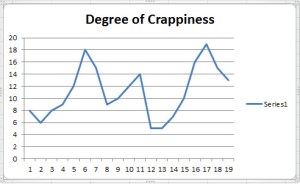
Two weeks ago I was feeling pretty good. I had been seeing a lot of improvement since starting a CPAP machine. I was on a new medication. Things were looking up! I was feeling better than I had in ages and I thought it would continue. The pattern was clear: 3-4 days of feeling great, 1-2 days of feeling crappy, and another day of feeling so-so. It wasn’t perfect, but it was a great sign that things would continue to improve. And then that pattern ended. I don’t know why. Technically, nothing changed. I thought I was in transition towards a better stage of health but maybe that wasn’t it, afterall.

I am trying to focus on the positive. I feel so much better than I did two years ago. I feel better than I did even 6 months ago. And I guess that’s the difference between me and Sisyphus: so far, I haven’t had to start over in this most recent journey. I slide backwards, but not completely. That means that the next time I improve, I’m starting from a higher point. It’s not perfect, but I’m grateful for it.

So right now, as the dark clouds are rolling in and my seasonal affective disorder is kicking up, as my body aches and the fatigue is ever-present, as I wonder if I’ll ever reach that carrot of a future, I’m trying very hard to see the last few years for what they’ve been, and be glad that, at least right now, I seem to be done with them.


Wondering how to give solicited medical advice

April 25, 2014

There’s a big difference between giving solicited and unsolicited medical advice. I think I’ve got a handle on giving unsolicited advice, but now a friend is asking for help and I’m not sure how to respond.

When you’re consumed with health issues, it’s easy to see them everywhere you look. I spend so much time and effort on getting enough sleep, eating the right foods, getting enough exercise, avoiding bad foods, etc., that it drives me up the wall to see people with more choices doing unhealthy things. The thing is, if the person doesn’t ask for advice, then offering it can be off-putting. They may be insulted or simply choose to ignore me. They probably aren’t ready to hear the message anyway. So I respond by posting tips to Facebook, where my family and friends can choose to read them or not. I’ll make comments that aren’t directed at them, just to get them thinking, like “Isn’t it terrible to think how many hormones people get from the animals they eat? I wish the FDA would do something about that.” I don’t badger anyone. This has been working out pretty well so far.

But when someone asks for advice, those rules go out the window. I’m back to wondering, how much is too much? If I give her too much information, will it scare her off? And can I trust my own perspective? I want to warn her that many doctors won’t run the right thyroid tests or prescribe the best medications. I know this is true. I’ve experienced it. I’ve read books about it. But if I tell her this now, before she’s found a doctor, will I be saving her from years of problems or will I be unnecessarily passing my own bias on to her?

I know that my friend needs help. She emailed me her blood test results and her symptoms yesterday. I will be honest that I can offer some good advice on some areas, but I don’t know anything about others. That’s fine. She knows that, and it won’t lower my credibility in her eyes. And she knows I’m not a doctor and won’t hold me liable for anything I suggest, so there’s no worry there. But I do see problems with her test results and her symptoms. She’s turning to me because she’s not getting great medical care. I want to help her. I just need to figure out the best way to do that.

How do you help friends who ask you for medical advice? Do you give advice or not? How much detail do you give? Do you warn them about the horrors of dealing with the medical community, or do you hold back on that? What else do you think I should consider?