Symptoms, spreadsheets, and connecting dots

December 30, 2020

When did I start feeling crappy? Was it two days ago? Last week? When’s the last time I was glutened? When did I last need to use a cane or crutches to get around my apartment? When did I adjust that medication? These things would be hard enough to remember under the best of circumstances, but add in brain fog and days on end without with the structure of a full time job and suddenly it feels impossible to remember with any accuracy. Thankfully, I have my spreadsheet.

It feels like I started the spreadsheet recently, but actually it was September 2013. (Wow, 7 years already!) I had been researching how to treat my various health conditions, and tracking symptoms and medications was recommended so strongly in multiple books that I finally gave in and did it. There are many apps that can be used, but I like my spreadsheet. Everything is in there, I don’t have to worry about an app being discontinued, it’s easy to search for any words or phrases I want, and I can use my laptop’s keyboard to type everything out (that’s much easier for me than tapping on a phone.) When I have random thoughts about things I want to add to the spreadsheet, I record them in the to-do list app on my phone, then later put them in the spreadsheet. Every morning I check my email and look at Facebook. While I’m at my computer, I update the spreadsheet. Easy. Occasionally I’ll pop in some information later in the day, too.

I started with a lot of categories which, to be honest, I never consistently used. There are some blank days, too. Interestingly, as of now (December 2020) there hasn’t been a blank day since March 2019. During the pandemic it’s easier to stay on top of this, but clearly my tracking improved long before that. Still, while blank days are less helpful, I try to remember that making notes sometimes is much better than making notes never.

So what do I record? As much as I can, here’s what I like to track:

  • The length of time I use my ASV machine each night. (An ASV is a form of CPAP machine, used to treat my sleep apnea.) Every morning when I wake up, the machine tells me how long it’s been on. This is also a fairly accurate record of how long I slept.
  • Any delays to taking my medication on a given day. Maybe I forgot. Maybe I ate a meal late and so I had to alter when I took a medication. This doesn’t usually matter, but sometimes I feel off and it helps to be able to look back and see if this was the reason. I’ll also note if I took it early for any reason, but this is rare.
  • My period, and how heavy it is that day. (I also note this in my calendar, for easy access during medical appointments.)
  • Any changes to medications or supplements. I note names of medications and supplements, doses, and times of day that I take them.
  • Any unusual symptoms, or changes in the degree of my symptoms. I’ll note if my right knee hurts one day, and what makes it worse. I’ll note if my fatigue suddenly hits me hard. I always note gastrointestinal symptoms.
  • Any other changes that I want to track. For example, I use a blue light every morning. These are commonly used to treat seasonal affective disorder (and it’s definitely helped mine!) but I use it primarily to adjust my sleep cycle. At my last appointment with my sleep specialist, I mentioned my recent difficulty going to bed at a reasonable hour each night. He suggested that I adjust when I use my blue light in the mornings, moving it earlier by a few minutes each day until I reach the target time. This is a huge struggle for me, as it means I need to get out of bed earlier. That’s not something I’m good at. So now I am writing down what time I use the blue each morning to be sure that I’m more or less on track. It’s taking me ages to move the light, but I look at my notes each morning to get encouragement that I’m moving in the right direction. I can also use it to see if the change in time (and hence a change in my sleep schedule) is impacting how I feel in other ways. Once I reach my goal, I will stop tracking this, but those notes will remain in the spreadsheet for those days. There are many things I track temporarily like this.
  • Unusual activities and overall symptoms levels. I’ll note if today felt like an especially productive day, if I was out at friend’s house all day without getting tired (pre-pandemic, of course), if I took an unusually long walk and how it made me feel, if a short walk made me tired or caused pain, if I stayed up too late the night before and how I feel as a result. I will also note outside factors, like if it’s a dark and dreary day, I will note that because it impacts my energy levels (remember the seasonal affective disorder I mentioned before? Yeah, weather is a big one) or if it’s hot out and I had to spend time outdoors then I’ll note it because that increases my inflammation levels.

As you can see, there are certain things that I track regularly, and others that I track temporarily. Some things are obvious (a change in medication) and some less so (the weather.) The key is, over time I have been figuring out what tends to impact my health and those are the things I note. This has been incredibly helpful.

Recently I was fatigued. It hit me suddenly, which was odd, but I figured maybe I’d been doing too much. I blamed my adrenal insufficiency, which was a reasonable assumption. After a few days I knew that wasn’t the issue, but didn’t know what was happening. Eventually I realized I’d been glutened. My symptom tracking showed me that the gluten explained my previously unexplainable knee swelling and the intense brain fog.

And then there was the time that I suddenly realized that I was having less brain fog. My thinking had been clearer for several days than it had been in a long time. I looked at my symptom tracking and noticed that, based on the timing, this was probably due to stopping some supplements. I had stopped taking those vitamins because they contained corn derivatives in the fillers, and I had recently decided to get more aggressive about cutting corn out of my diet, since I knew I reacted badly to it in larger quantities. It had been immediately obvious that cutting out those smaller bits of corn was helping my digestive issues, but it was only thanks to my tracking that I realized its impact on my cognition.

I could give you dozens of examples of my symptom tracking spreadsheet helping me over the years. It’s not perfect, but for me it works. Ideally I would like to track a lot more information, but I have found that when I try to do more, I get overwhelmed and end up doing nothing at all. Something is better than nothing, so for now, I will continue to do this.

This works well for me, but I know it’s not the right approach for everyone. Please share what works for you, too, because it may give others some useful ideas. Do you track your symptoms? If so, what do you track and what program do you use? What would you recommend to others? I hope that everyone who wants to track their symptoms can find an approach that works well for them.


Worried about getting medical care

June 19, 2020

I have been very fortunate: so far, I have been able to stay isolated. I leave my apartment for occasional walks, wearing a mask and keeping my distance from people. The only indoor space I have entered is the main building of my apartment complex where I have gone a few times to pick up packages; even then, I have been able to keep my distance from people. I have even been able to have short visits with my parents. We stay outdoors, at least 10 feet apart, wearing masks. It’s not ideal, but I’m very grateful for those visits. I have been very lucky, but how long can that last?

2020-06-02 17.42.29

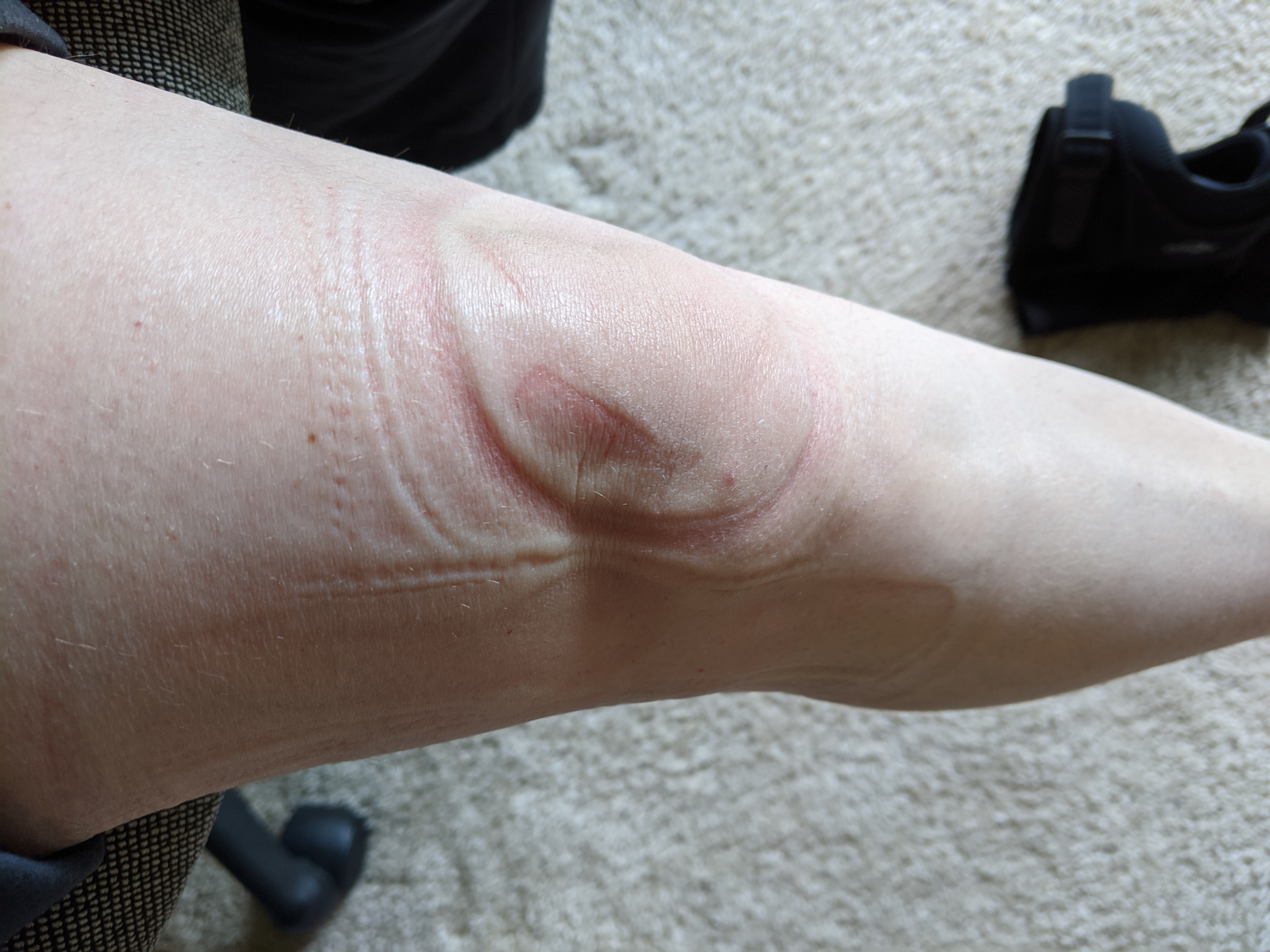
From the start I knew I would likely break isolation for medical treatment. I didn’t know when or why, but I figured that would be the reason and it looks like I might be right. Frankly, it’s a bit shocking that I have been able to go for 3 months without in-person medical treatment. I am feeling the effects, of course. My muscles are spasming, I haven’t gotten my period in more than 4 months, my knees are so inflamed that my knee braces no longer fit (those marks on my knee are definitely not ok!), and I am pretty sure that I have increased inflammation throughout my body. It’s not good.

On top of that, I am due for a lot of followup blood tests, one doctor wants me to get xrays, and I can not get the new orthodics that I have needed for months and which insurance will finally cover as of last week. Some of the blood tests I should get are routine. Some are following up on issues which are probably fine. But one is to follow up on something potentially serious. I should have gotten the tests done last month, but we have been waiting.

My doctors are weighing risks versus rewards, and they are not in agreement. One thinks I should get blood tests while another thinks that I should wait. One thought I should wait for physical therapy but now has changed their mind. Of course, each doctor has different considerations. My need for physical therapy wasn’t as big last month as it is now. Some blood tests are more necessary than others. Some doctors are more conservative than others. Some are more aware of my risk factors than others.

I am not as high-risk for Covid-19 complications and some folks. Still, I am more at risk than many, and I do not want to put myself at risk if I can avoid it. Then again, my symptoms will only continue to get worse and it is not as if it is a matter of waiting just one more month. It could be a year or more before I can safely see any of my medical practitioners, so waiting might not be the best approach.

Logically, I know that now might be a good time to get treatment. After all, the numbers are expected to go up soon. Still, it doesn’t feel safe. We don’t know much more about this illness than we did in March. We don’t have any additional safety measures, either, except for wearing masks.

So I am scared, unsure, and worried that I will make the wrong decision. There is no “right” decision, though. I don’t have a crystal ball. Sooner or later I will need to get medical care and I will either become ill or I won’t but until then, the best I can do is make a guess.

I am beyond frustrated that people in my area, and especially politicians, are not taking this situation more seriously. I am watching them engage in risky behavior that could contribute to the spread of this virus for the sake of a meal at a restaurant or a haircut, while people like me are delaying important medical care. And even as I type this, I am in so much pain that could be alleviated with physical therapy. It is so unfair.

Like I said, I know that I am lucky. Many people have not had the option of delaying medical care. Some of them have been able to get care without incident, while others were not as fortunate. I look forward to the day when we can all access care without fear (or at least with much less fear) of contracting this virus.

What has your experience been like accessing medical care during this time? And where are you located? I know that the situation is very different in different countries (and even in different regions within my own country.) Please comment and share, because I’m curious to know what others are doing. Best of luck to you all!


How to value our lives

April 26, 2020

With hospitals becoming overwhelmed with COVID-19 patients, choices have to be made. Who will be treated first? If there aren’t enough ventilators for everyone, which patients will get one, and which won’t? This is a difficult conversation to have. Unfortunately, many places are putting policies in place which devalue the lives of people with chronic illnesses.

Part of the rationale is that people with certain medical conditions will take more care than people who are otherwise healthy. I understand that spending 10x more hours on 1 patient means that others will receive less care. Another part of the rationale is that the focus should people in the patients with the greatest potential health outcomes. If the choice is between saving the life of someone who is 70 or saving the life of someone who is 30, this reasoning says the 30-year-old should be saved because they are likely to live longer than the 70-year-old would, even if both recover fully. And if two 30-year-olds need treatment, one with a chronic illness and one without, the guidelines say to treat the one without chronic illness first. In fact, a ventilator may be taken away from the chronically ill patient and given to the otherwise healthy patient!

This is where these conversations often quickly devolve into which lives are most “worth” saving, both amongst policy makers and amongst everyone else. I have a lot of issues with this. Yes, I have chronic illnesses. Yes, my care could be more complicated than the care for someone who has no chronic illnesses. But does that make my life less worth saving? Does that make me a less valuable person?

In the chronic illness world, we say that our productivity does not determine our worth. That is so true. I’m biased, of course, but I think my life has a lot of value. I have not had a full time job in more than 8 years but, contrary to what many believe, that does not mean that I haven’t contributed to society in that time.

On a smaller scale, I am a good friend and daughter. I provide advice, let loved ones cry on my shoulder, celebrate good times, and more. I also do volunteer work in formal settings and provide help to many people in informal ways. (So many friends and friends of friends have sought my advice on how to approach doctors, how to research health problems, or even how to fix a computer problem. Earlier this month I even helped a couple of friends do their taxes.) I have written a book about chronic illnesses, I stop to hold open the door for strangers (pre-pandemic, that is), and I do random acts of kindness (like when a kid at the convenience store could afford the food he’d picked up, so I paid the balance – again, pre-pandemic.) I write this blog, which I believe helps people. Does it change the world? No. Does it change some tiny part of it? I hope so.

Why is all of this considered to be worth nothing simply because I don’t have a job? Infuriatingly, people are arguing that’s the case.

And what if you can’t do any of the above? Your life still has value, and you deserve to be treated as such. These are just examples from my own life. I’m sure you can offer your own examples, past, present, or aspiring to in the future.

What’s more, why should someone be treated as “better” because they are “healthy” and work full time regardless of other factors? Is a CEO who earns millions while harming others somehow superior? What about people who are racist or homophobic but work full time? What about people who steal or assault others? What about those who are just plain mean? Why is working at a job so often a litmus test, while these other factors are completely ignored.

To be clear, I am not suggesting that patients must pass tests to prove they are “good” people before receiving treatment. I am simply pointing out that there are many factors that *could* be used when the conversation turns to who is most “worth” saving, yet so often people talk about folks who receive government benefits and who do not work at jobs as having less perceived value. This hurts. They are saying that I have less value. They are saying that people I care about have less value. They are saying that we should be allowed to die so that someone else might be saved, and that this choice is being made solely due to our having chronic illnesses.

That is why I am standing up today to say that I have value. And so do you.


Medications: too little science, too much art

February 24, 2020

What dose should I take? That has never had a clear answer for me.

As a kid in severe pain, the doctors told me to take 3 ibuprofen. They said they wanted me to take 4, but held back because of my size. I was probably around 14 years old then, and under 100 pounds. The thing is, size isn’t the only way to dose a medication. Oops.

As an adult, something slowly became clear: I need small doses of everything. I’m still not a huge person, but I’m certainly well over 100 pounds, and I react strongly to everything.

2020-02-24 11.26.10

A typical starting dose of melatonin is 1-3 mg. I take 75 mcg! I have empty pill capsules which I use to split capsules that, even at their lowest dose, are too strong for me. I open them up and carefully pour the contents into the empty capsules, dividing each pill into 2 or 3 doses. It’s a pain in the butt, but necessary.

Now I’m taking a compounded hycrocortisone (HC). Since it’s a compound, it’s easy to get any dose I need. You know what isn’t easy? Knowing which dose I need!

A book I trust insists that women should start at 25 mg. Patient groups I trust also say to start at 25-30 mg. My doctor says that 15 mg is the right dose. I started at 15 mg and quickly ramped up to 25 mg. I felt much better. After several months, though, I suddenly gained a lot of weight all at once. My doctor felt it was due to the HC and wants me to lower the dose. Given the way I gained the weight (the timing and location) I have to admit that he’s probably right. I had a few other symptoms, too, which could be related. Still, I was hesitant. I felt good, after all. And while for some medications, blood or other tests will give answers as to a medication’s efficacy and impact, HC messes with adrenal tests and makes the results unreliable. Dosing is based only on symptoms. Oy!

If only there was some way to know what the right dose is!

I decided to lower my dose a bit at least. I went down to 22.5 mg. In less than a week I got my period for the first time in months. I don’t think that was a coincidence. There’s been no change in my weight, but I know from experience that steroidal weight gain is a bitch to reverse, so I’m not expecting it to magically disappear on its own.

I’ve had some other good effects, though. I seem to be sleeping better, and I’m waking up feeling more alert and less fatigued. Hmm. That’s appealing.

The question now is: what do I do next? Do I lower the dose a bit more? Hold it at 22.5 mg because it’s working? Change the timing of the pills? I wish I knew!

Unfortunately, there’s no choice but to experiment. This week I will lower my dose again, down to 20 mg, and see what happens. It might be great. I might feel even better. On the other hand, I could feel a whole lot worse. Unfortunately, there’s absolutely no way to know in advance. I just have to try it.