Worried about getting medical care

June 19, 2020

I have been very fortunate: so far, I have been able to stay isolated. I leave my apartment for occasional walks, wearing a mask and keeping my distance from people. The only indoor space I have entered is the main building of my apartment complex where I have gone a few times to pick up packages; even then, I have been able to keep my distance from people. I have even been able to have short visits with my parents. We stay outdoors, at least 10 feet apart, wearing masks. It’s not ideal, but I’m very grateful for those visits. I have been very lucky, but how long can that last?
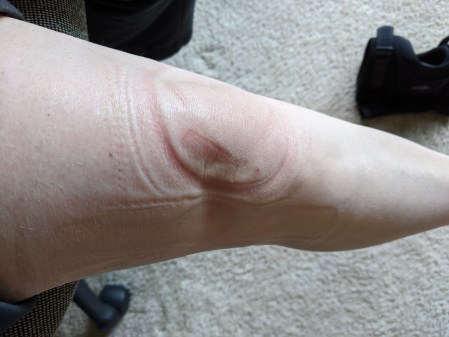
2020-06-02 17.42.29

From the start I knew I would likely break isolation for medical treatment. I didn’t know when or why, but I figured that would be the reason and it looks like I might be right. Frankly, it’s a bit shocking that I have been able to go for 3 months without in-person medical treatment. I am feeling the effects, of course. My muscles are spasming, I haven’t gotten my period in more than 4 months, my knees are so inflamed that my knee braces no longer fit (those marks on my knee are definitely not ok!), and I am pretty sure that I have increased inflammation throughout my body. It’s not good.

On top of that, I am due for a lot of followup blood tests, one doctor wants me to get xrays, and I can not get the new orthodics that I have needed for months and which insurance will finally cover as of last week. Some of the blood tests I should get are routine. Some are following up on issues which are probably fine. But one is to follow up on something potentially serious. I should have gotten the tests done last month, but we have been waiting.

My doctors are weighing risks versus rewards, and they are not in agreement. One thinks I should get blood tests while another thinks that I should wait. One thought I should wait for physical therapy but now has changed their mind. Of course, each doctor has different considerations. My need for physical therapy wasn’t as big last month as it is now. Some blood tests are more necessary than others. Some doctors are more conservative than others. Some are more aware of my risk factors than others.

I am not as high-risk for Covid-19 complications and some folks. Still, I am more at risk than many, and I do not want to put myself at risk if I can avoid it. Then again, my symptoms will only continue to get worse and it is not as if it is a matter of waiting just one more month. It could be a year or more before I can safely see any of my medical practitioners, so waiting might not be the best approach.

Logically, I know that now might be a good time to get treatment. After all, the numbers are expected to go up soon. Still, it doesn’t feel safe. We don’t know much more about this illness than we did in March. We don’t have any additional safety measures, either, except for wearing masks.

So I am scared, unsure, and worried that I will make the wrong decision. There is no “right” decision, though. I don’t have a crystal ball. Sooner or later I will need to get medical care and I will either become ill or I won’t but until then, the best I can do is make a guess.

I am beyond frustrated that people in my area, and especially politicians, are not taking this situation more seriously. I am watching them engage in risky behavior that could contribute to the spread of this virus for the sake of a meal at a restaurant or a haircut, while people like me are delaying important medical care. And even as I type this, I am in so much pain that could be alleviated with physical therapy. It is so unfair.

Like I said, I know that I am lucky. Many people have not had the option of delaying medical care. Some of them have been able to get care without incident, while others were not as fortunate. I look forward to the day when we can all access care without fear (or at least with much less fear) of contracting this virus.

What has your experience been like accessing medical care during this time? And where are you located? I know that the situation is very different in different countries (and even in different regions within my own country.) Please comment and share, because I’m curious to know what others are doing. Best of luck to you all!


What’s the deal with haircuts?

May 28, 2020

I ask this in all seriousness: why are people risking their lives for haircuts?

If you live in another country, you might not know what I’m talking about. Here in the U.S., businesses are opening up again. In many states, hair salons have opened, and people are flocking to them. In my state of Massachusetts, that is happening this week. Even though hair salons pose a higher risk than many other businesses, they are among the first to open because of public demand. Reopening is happening based on politics, not science.

I can’t understand why people are running for haircuts. They celebrate on social media, “Yay, I booked an appointment!” I don’t get it.

To be fair, I have never been as fashion-conscious as most. Still, I would love to get my haircut. I just don’t think it’s worth risking my life or the lives of those with whom I come into contact. Why are people acting like it’s so urgent? Why not wait?

Obviously, I would love to go out. If it were safe to do so, here’s what I would love to do, in order of preference:

  1. Hug my parents.
  2. See my physical therapist.
  3. See my occupational therapist.
  4. Get some needed blood work.
  5. Visit with close friends.
  6. Take a walk without worrying about being too close to people.
  7. Pet every dog I see.
  8. Buy my own groceries (especially so that I can manage my food restrictions better.)
  9. Visit with my parents. Yup, they definitely deserve to be on this list twice.
  10. Travel. Preferably to someplace on the ocean. (Even if it were only an hour away.)

Getting a haircut isn’t in my top 10. I doubt it’s even in my top 20. Yes, I’d love to get my hair cut, and if it were safe, I would probably plan to do it in the coming weeks, but it’s far from a top priority. So I just don’t understand the obsession. I’m sure that some people feel that it’s safe (at lease for them.) But what about everyone else? Can you explain it to me, because I would really love to understand.

Meanwhile, have you thought about your top 10 priorities for when those things become safe? Or even your top 5 or top 3? Please share as many as you feel comfortable sharing!


How to value our lives

April 26, 2020

With hospitals becoming overwhelmed with COVID-19 patients, choices have to be made. Who will be treated first? If there aren’t enough ventilators for everyone, which patients will get one, and which won’t? This is a difficult conversation to have. Unfortunately, many places are putting policies in place which devalue the lives of people with chronic illnesses.

Part of the rationale is that people with certain medical conditions will take more care than people who are otherwise healthy. I understand that spending 10x more hours on 1 patient means that others will receive less care. Another part of the rationale is that the focus should people in the patients with the greatest potential health outcomes. If the choice is between saving the life of someone who is 70 or saving the life of someone who is 30, this reasoning says the 30-year-old should be saved because they are likely to live longer than the 70-year-old would, even if both recover fully. And if two 30-year-olds need treatment, one with a chronic illness and one without, the guidelines say to treat the one without chronic illness first. In fact, a ventilator may be taken away from the chronically ill patient and given to the otherwise healthy patient!

This is where these conversations often quickly devolve into which lives are most “worth” saving, both amongst policy makers and amongst everyone else. I have a lot of issues with this. Yes, I have chronic illnesses. Yes, my care could be more complicated than the care for someone who has no chronic illnesses. But does that make my life less worth saving? Does that make me a less valuable person?

In the chronic illness world, we say that our productivity does not determine our worth. That is so true. I’m biased, of course, but I think my life has a lot of value. I have not had a full time job in more than 8 years but, contrary to what many believe, that does not mean that I haven’t contributed to society in that time.

On a smaller scale, I am a good friend and daughter. I provide advice, let loved ones cry on my shoulder, celebrate good times, and more. I also do volunteer work in formal settings and provide help to many people in informal ways. (So many friends and friends of friends have sought my advice on how to approach doctors, how to research health problems, or even how to fix a computer problem. Earlier this month I even helped a couple of friends do their taxes.) I have written a book about chronic illnesses, I stop to hold open the door for strangers (pre-pandemic, that is), and I do random acts of kindness (like when a kid at the convenience store could afford the food he’d picked up, so I paid the balance – again, pre-pandemic.) I write this blog, which I believe helps people. Does it change the world? No. Does it change some tiny part of it? I hope so.

Why is all of this considered to be worth nothing simply because I don’t have a job? Infuriatingly, people are arguing that’s the case.

And what if you can’t do any of the above? Your life still has value, and you deserve to be treated as such. These are just examples from my own life. I’m sure you can offer your own examples, past, present, or aspiring to in the future.

What’s more, why should someone be treated as “better” because they are “healthy” and work full time regardless of other factors? Is a CEO who earns millions while harming others somehow superior? What about people who are racist or homophobic but work full time? What about people who steal or assault others? What about those who are just plain mean? Why is working at a job so often a litmus test, while these other factors are completely ignored.

To be clear, I am not suggesting that patients must pass tests to prove they are “good” people before receiving treatment. I am simply pointing out that there are many factors that *could* be used when the conversation turns to who is most “worth” saving, yet so often people talk about folks who receive government benefits and who do not work at jobs as having less perceived value. This hurts. They are saying that I have less value. They are saying that people I care about have less value. They are saying that we should be allowed to die so that someone else might be saved, and that this choice is being made solely due to our having chronic illnesses.

That is why I am standing up today to say that I have value. And so do you.


Changing the subject

April 23, 2020

All roads, and conversations, lead back to coronavirus. That’s how it feels these days. It’s exhausting.

Even the things that aren’t explicitly about cornavirus end up being related. Someone asks what I did with my afternoon. I made masks. I ask them about their weekend plans. They can’t go out, so they’ll be working on a jigsaw puzzle. I suppose it’s inevitable that when our lives become so collectively upended, we’re going to keep talking about it. Of course, for those of us with chronic illness who know that family and friends get tired of hearing about our illness, this feels a bit hypocritical. But I hope that it leads to more compassion going forward.

Personally, I find it stressful to be constantly focused on the pandemic, so I handle it in the best way I know how: I change the subject. I ask what books they’ve read, what movie’s they’ve watched. I ask about their job, about their kids, about the weather. I tell them about something interesting that I read or did.

Sometimes a subject change isn’t enough. They keep coming back to the big C. More than once, I have explicitly told someone, “Talking about this is stressing me out. Do you mind if we talk about something else?” If that doesn’t work and they keep going back to it, or if there’s a group of us talking, I’ll say, “I can’t handle talking about this right now. Let’s talk another time.” Is it rude? Maybe. I try to keep it light, but I can’t control how someone else takes it. And at the end of the day, my own mental health is important.

Some people feel the need to talking about the pandemic and our collective isolation. I get that. For them, talking about it is helpful. It’s a way to vent. For others, it becomes an unhealthy obsession. Either way, it’s not healthy for me to talk about it. Oh sure, I discuss it here and there. It’s hard not to. But when I feel myself being drawn in, feeling stressed, or otherwise responding badly, I pull away. I change the subject.

Maybe you’re someone who wants to talk about this situation constantly. Maybe, you feel the need to discuss it about 99% less than you currently do. Likely, you fall somewhere in the middle. Regardless, I encourage you to figure out what your sweet spot is, then figure out how to reach it. It can be difficult to finesse conversations. I get that. It can’t always be done, like in formal settings when the manager says, “Let’s all go around the group and talk about how we’re doing before we start things.” I understand why they do that, but it stresses me out and I wish they wouldn’t. Sometimes I leave the conversation. Most of the time I stick it out, and that’s why it’s more important than ever that my social conversations remain social and not stressful. I hope that you can find a way to get the social conversations that you need as well.

What have your conversations been like regarding the pandemic? Have you found a balance that works for you? Would you like to discuss it less or more? Please comment below and share your perspectives and experiences!
