Worried about getting medical care

June 19, 2020

I have been very fortunate: so far, I have been able to stay isolated. I leave my apartment for occasional walks, wearing a mask and keeping my distance from people. The only indoor space I have entered is the main building of my apartment complex where I have gone a few times to pick up packages; even then, I have been able to keep my distance from people. I have even been able to have short visits with my parents. We stay outdoors, at least 10 feet apart, wearing masks. It’s not ideal, but I’m very grateful for those visits. I have been very lucky, but how long can that last?
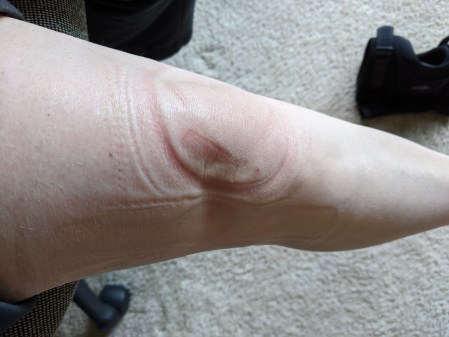
2020-06-02 17.42.29

From the start I knew I would likely break isolation for medical treatment. I didn’t know when or why, but I figured that would be the reason and it looks like I might be right. Frankly, it’s a bit shocking that I have been able to go for 3 months without in-person medical treatment. I am feeling the effects, of course. My muscles are spasming, I haven’t gotten my period in more than 4 months, my knees are so inflamed that my knee braces no longer fit (those marks on my knee are definitely not ok!), and I am pretty sure that I have increased inflammation throughout my body. It’s not good.

On top of that, I am due for a lot of followup blood tests, one doctor wants me to get xrays, and I can not get the new orthodics that I have needed for months and which insurance will finally cover as of last week. Some of the blood tests I should get are routine. Some are following up on issues which are probably fine. But one is to follow up on something potentially serious. I should have gotten the tests done last month, but we have been waiting.

My doctors are weighing risks versus rewards, and they are not in agreement. One thinks I should get blood tests while another thinks that I should wait. One thought I should wait for physical therapy but now has changed their mind. Of course, each doctor has different considerations. My need for physical therapy wasn’t as big last month as it is now. Some blood tests are more necessary than others. Some doctors are more conservative than others. Some are more aware of my risk factors than others.

I am not as high-risk for Covid-19 complications and some folks. Still, I am more at risk than many, and I do not want to put myself at risk if I can avoid it. Then again, my symptoms will only continue to get worse and it is not as if it is a matter of waiting just one more month. It could be a year or more before I can safely see any of my medical practitioners, so waiting might not be the best approach.

Logically, I know that now might be a good time to get treatment. After all, the numbers are expected to go up soon. Still, it doesn’t feel safe. We don’t know much more about this illness than we did in March. We don’t have any additional safety measures, either, except for wearing masks.

So I am scared, unsure, and worried that I will make the wrong decision. There is no “right” decision, though. I don’t have a crystal ball. Sooner or later I will need to get medical care and I will either become ill or I won’t but until then, the best I can do is make a guess.

I am beyond frustrated that people in my area, and especially politicians, are not taking this situation more seriously. I am watching them engage in risky behavior that could contribute to the spread of this virus for the sake of a meal at a restaurant or a haircut, while people like me are delaying important medical care. And even as I type this, I am in so much pain that could be alleviated with physical therapy. It is so unfair.

Like I said, I know that I am lucky. Many people have not had the option of delaying medical care. Some of them have been able to get care without incident, while others were not as fortunate. I look forward to the day when we can all access care without fear (or at least with much less fear) of contracting this virus.

What has your experience been like accessing medical care during this time? And where are you located? I know that the situation is very different in different countries (and even in different regions within my own country.) Please comment and share, because I’m curious to know what others are doing. Best of luck to you all!


Finding my new (figurative) voice

May 21, 2020

I haven’t written here for a while, and I have been trying to figure out why I feel less motivated. Is it the pandemic? Is it that I have run out of things to rant about after nearly 9 years (wow!) of this blog? I have finally had to admit to myself that it’s neither; it’s my book.

Many years ago, I decided to write a book about living with chronic illness. I plodded along slowly for several years, finally picking up the pace about a year ago. More recently, I have been spending a lot of time working on it. But lack of time isn’t why I haven’t been writing here.

In addition to the time I have spent on the book itself, I have also spent a lot of time talking and writing about the book. I am in writing groups with other authors, I talk to family and friends about it, I talk to interested strangers about it, I post about it on social media, I write about it to the followers on my email list. But the effort of talking and writing about the book isn’t what is stopping me from writing here, either.

Finally I figured it out: it’s my voice. You see, I chose to write the book under my real name. I am sharing a lot more there than I am used to sharing publicly. At the same time, I am sharing less than what I have shared on this site. I am finding a new balance, and in the process, I am holding back on some things. The question I ask myself isn’t, “Should I talk about this in an email or on the blog?” Instead, it’s, “Should I talk about this under my real name or use my pseudonym?” For years I leaned towards the latter but more recently I have been leaning towards the former. And as I share more with my other audience under my real name, I struggle with not sharing those same stories here. After all, how can I maintain my anonymity here if I share the same story under my real name?

Don’t worry, though, I am not abandoning this blog! Instead, I am simply finding a new balance. As with many things in life, this is not a one-time task but an ongoing process. At the beginning of the book, I had to find that balance and I did. Now am finding it again, and the pandemic only complicates things. When I eventually publish the book, I am sure I will need to find that balance again. This is just how things go. But I am sure that I will be find my ranting mojo before too long.

Meanwhile, I would love to know, have any of you ever written books about chronic illness? If so, did you write under your real name or a pseudonym? Did you enjoy it? Was it well-received? Please tell me all about it in the comments! Feel free to share the link to your book so that others can find it, too.

As for the link to my book, well, first of all the book isn’t done yet, so there’s no link. But also, there’s that whole anonymity thing again. If I share the link to a book that’s under my own name, then I won’t be so anonymous anymore, will I? And while I may one day be comfortable sharing all of the stories about myself that are on this blog (I’m mostly comfortable with that now, in fact), there are some stories here about family, friends, dates, and others that are not mine to share. I always checked with them before writing those stories, but they agreed to be mentioned on a blog that was anonymous, and it wouldn’t be right to change that now. So this blog will remain anonymous. Still, my hope is that when my book is one day published, you will find it anyhow. And that it will bring you joy and comfort.


Changing the subject

April 23, 2020

All roads, and conversations, lead back to coronavirus. That’s how it feels these days. It’s exhausting.

Even the things that aren’t explicitly about cornavirus end up being related. Someone asks what I did with my afternoon. I made masks. I ask them about their weekend plans. They can’t go out, so they’ll be working on a jigsaw puzzle. I suppose it’s inevitable that when our lives become so collectively upended, we’re going to keep talking about it. Of course, for those of us with chronic illness who know that family and friends get tired of hearing about our illness, this feels a bit hypocritical. But I hope that it leads to more compassion going forward.

Personally, I find it stressful to be constantly focused on the pandemic, so I handle it in the best way I know how: I change the subject. I ask what books they’ve read, what movie’s they’ve watched. I ask about their job, about their kids, about the weather. I tell them about something interesting that I read or did.

Sometimes a subject change isn’t enough. They keep coming back to the big C. More than once, I have explicitly told someone, “Talking about this is stressing me out. Do you mind if we talk about something else?” If that doesn’t work and they keep going back to it, or if there’s a group of us talking, I’ll say, “I can’t handle talking about this right now. Let’s talk another time.” Is it rude? Maybe. I try to keep it light, but I can’t control how someone else takes it. And at the end of the day, my own mental health is important.

Some people feel the need to talking about the pandemic and our collective isolation. I get that. For them, talking about it is helpful. It’s a way to vent. For others, it becomes an unhealthy obsession. Either way, it’s not healthy for me to talk about it. Oh sure, I discuss it here and there. It’s hard not to. But when I feel myself being drawn in, feeling stressed, or otherwise responding badly, I pull away. I change the subject.

Maybe you’re someone who wants to talk about this situation constantly. Maybe, you feel the need to discuss it about 99% less than you currently do. Likely, you fall somewhere in the middle. Regardless, I encourage you to figure out what your sweet spot is, then figure out how to reach it. It can be difficult to finesse conversations. I get that. It can’t always be done, like in formal settings when the manager says, “Let’s all go around the group and talk about how we’re doing before we start things.” I understand why they do that, but it stresses me out and I wish they wouldn’t. Sometimes I leave the conversation. Most of the time I stick it out, and that’s why it’s more important than ever that my social conversations remain social and not stressful. I hope that you can find a way to get the social conversations that you need as well.

What have your conversations been like regarding the pandemic? Have you found a balance that works for you? Would you like to discuss it less or more? Please comment below and share your perspectives and experiences!


Medications: too little science, too much art

February 24, 2020

What dose should I take? That has never had a clear answer for me.

As a kid in severe pain, the doctors told me to take 3 ibuprofen. They said they wanted me to take 4, but held back because of my size. I was probably around 14 years old then, and under 100 pounds. The thing is, size isn’t the only way to dose a medication. Oops.

As an adult, something slowly became clear: I need small doses of everything. I’m still not a huge person, but I’m certainly well over 100 pounds, and I react strongly to everything.

2020-02-24 11.26.10

A typical starting dose of melatonin is 1-3 mg. I take 75 mcg! I have empty pill capsules which I use to split capsules that, even at their lowest dose, are too strong for me. I open them up and carefully pour the contents into the empty capsules, dividing each pill into 2 or 3 doses. It’s a pain in the butt, but necessary.

Now I’m taking a compounded hycrocortisone (HC). Since it’s a compound, it’s easy to get any dose I need. You know what isn’t easy? Knowing which dose I need!

A book I trust insists that women should start at 25 mg. Patient groups I trust also say to start at 25-30 mg. My doctor says that 15 mg is the right dose. I started at 15 mg and quickly ramped up to 25 mg. I felt much better. After several months, though, I suddenly gained a lot of weight all at once. My doctor felt it was due to the HC and wants me to lower the dose. Given the way I gained the weight (the timing and location) I have to admit that he’s probably right. I had a few other symptoms, too, which could be related. Still, I was hesitant. I felt good, after all. And while for some medications, blood or other tests will give answers as to a medication’s efficacy and impact, HC messes with adrenal tests and makes the results unreliable. Dosing is based only on symptoms. Oy!

If only there was some way to know what the right dose is!

I decided to lower my dose a bit at least. I went down to 22.5 mg. In less than a week I got my period for the first time in months. I don’t think that was a coincidence. There’s been no change in my weight, but I know from experience that steroidal weight gain is a bitch to reverse, so I’m not expecting it to magically disappear on its own.

I’ve had some other good effects, though. I seem to be sleeping better, and I’m waking up feeling more alert and less fatigued. Hmm. That’s appealing.

The question now is: what do I do next? Do I lower the dose a bit more? Hold it at 22.5 mg because it’s working? Change the timing of the pills? I wish I knew!

Unfortunately, there’s no choice but to experiment. This week I will lower my dose again, down to 20 mg, and see what happens. It might be great. I might feel even better. On the other hand, I could feel a whole lot worse. Unfortunately, there’s absolutely no way to know in advance. I just have to try it.
