My calendar says I’m recovering that day

April 19, 2016

I used to call them do-nothing days. Or resting days. Or dead days. Lately I’ve been calling them Recovery Days. Because that’s what they are. I’m not doing nothing, I’m recovering!Recovery Day
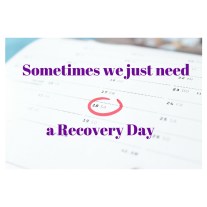
Our culture says that a day of watching tv when you should be buying groceries and cleaning and going to a job and and and…. is lazy. I say that if you have a chronic illness, sometimes it’s necessary.

I had a recovery day yesterday. I could have pushed myself. I had a long list of things to do. If I’d pushed myself I might have been able to get a couple of things done. But I wouldn’t have gotten far on that list, and I would have done things badly. Then I’d have felt lousy today and I’d have barely gotten anything done at all. Sound familiar?

I used to push myself. At the time it seemed like a good idea. Now I know that pushing myself too much just means I’ll eventually hit the wall and I won’t be able to do anything at all.

So instead I took a Recovery Day. I didn’t leave the apartment. I read. I watched tv. I heated up leftovers for meals. That was it.

And today I felt better! I was able to go out and run errands. I’m sitting in a chair and writing this now (not an easy thing!) For me, that’s a super productive day.

Sometimes my Recovery Days are predictable. I can look at my calendar right now and tell you that I’ll be taking a Recovery Day on Sunday, so that’s blocked out on my calendar. I knew I’d probably be taking one yesterday, too, but I wasn’t completely sure until around 10am. I could just feel it, and there was no doubt it’s what I needed.

I used to take Recovery Days 3-5 days per week. If I left the house for an hour, the next day would be a Recovery Day. These days I’m feeling better and I only need them 1-2 times per week – yay! Of course, even now I have bad weeks, too. Sometimes a Recovery Day means spending all day in pajamas and doing nothing but watching tv. Sometimes it’s multiple days of that. Yesterday I felt better and was able to read a novel for a while. All that really matters, though, is that I gave my body the rest that it needed, in the form that it needed.

I know I’m lucky. I don’t have children or anyone else to take care of. I’m not working (though that’s not exactly a good thing.) So I’m able to spend an entire day indoors. I’m able to rest when I need to. But there are other things I should do on my Recovery Days that I can’t. I accommodate myself the best that I can. That’s all any of us can do.

You might have noticed that I’ve been capitalizing Recovery Day. That’s because it’s IMPORTANT! I think we don’t give ourselves enough credit for how hard these days are. We let culture pressure us into thinking we’re not doing enough when in reality we’re doing so much. Sometimes, it’s all we can do to get through these days. I’d rather go to the gym for 4 hours than need some of these Recovery Days. But I don’t have a choice, and I accept that (but it took me many years to finally accept it.)

How do you feel about your Recovery Days? Are you willing to rest when your body needs it? What do you do? How do you handle it? Please let me know in the comments so we can learn from each other!


The reminder system all doctors should use

April 14, 2016

Sometimes it’s helpful to get a reminder about a medical appointment. But sometimes it’s just really annoying.

When they call at 8:30 and I’m still asleep, I don’t want that call. When I’m busy, I don’t want that call. When I have 5 appointments coming up and they all seem to call on the same day, I definitely don’t want those calls.

Except I sort of do. Reminders can be helpful when I’m dealing with dozens of appointments every year.

And that’s why I think my dentist’s reminder system is brilliant and I don’t understand why more don’t do this.

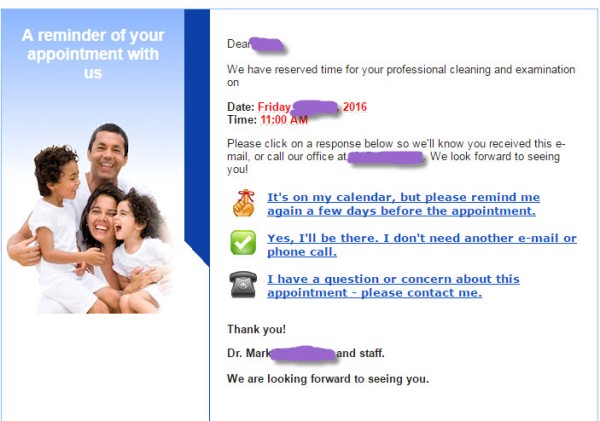
3-28-2016 12-40-29 PM

See this email message? How great is this?! As soon as I make an appointment I get this message. I click on one of the options. If I don’t want a reminder phone call I won’t get one! If i click to be reminded, they send another email a few days before the appointment. If I don’t click on any of the options in that message, they call me. If someone doesn’t want to give the office an email address, they call instead.

Yes, I’m sure this isn’t cheap for them. But then again, think of all of the staff hours they save by not having someone calling all of their patients! And instead of leaving messages on voicemail systems that might be garbled, they get to send a clear, simple email message.

And on my end, I find this so much better than a phone call! It’s not disruptive, I can easily see the date and time, and it’s quick and easy to respond.

A simpler version is the bland, impersonal, highly useful email I get from my naturopath a couple days before each appointment. I don’t know if she sends those manually or if they’re automated, but either way, they’re simple. They remind me of my appointment. They say the date and time. I don’t need to respond. I don’t have to do anything. I don’t even have to deal with a phone call.

Some people prefer phone calls, and it’s great that they still have that option. But it’s 2016 now. It’s about time more medical offices catch up and use email to confirm appointments. Then maybe in another 20 years they’ll be ready to use apps!

Is this unusual? What do your medical providers do? Please comment and let me know – I’m very curious!


The strangeness of “I could never do that”

April 13, 2016

Me: I don’t eat gluten.
Them: I could never give up gluten.IMG_20160413_173002

Me: I can’t jog or do any exercise.
Them: I could never stop exercising.

I hear this response over and over. The “I could never….” response. And over and over I have the same response: you really don’t get it.

Let’s take gluten as an example. When I say I can’t eat gluten, even though the other person knows it’s for health reasons, they’ll say, “I could never give that up.” What do they mean? It’s not as if I gave up gluten on a whim. No one offered me a cure for Celiac and I said, “Thanks, but no thanks.” I wasn’t asked, would you like to give up gluten just for the hell of it?” No, this is necessary for me to live.

So when someone says, “I could never give them up,” what I hear is, “I would rather die.” Because that’s the other option. Give up gluten or die. No, death wouldn’t come immediately, but it would come eventually. And in the meantime there would be a lot of horrible nausea, pain, and other symptoms.

When someone says, “I could never do that” they probably mean that they’re impressed that I can do it. As if I have a choice. They probably mean it in a nice way. But it doesn’t feel that way. Because the other thing I hear is, “I love this thing so much, I can’t imagine living without it, but you can’t have it.” Again, I know they don’t mean it that way, but that’s how I hear it. They get it and I don’t.

Exercise is the same thing. When someone says, “I could never give up skiing/jogging/dancing/kickboxing/some-other-form-of-physical-exertion” what I hear is, “I would rather die” or “I love this thing so much that my life wouldn’t be complete without it, so your life must really be lacking.” I’m sure they don’t mean to convey that message, even though I do get the feeling they’re privately thinking it. Because what else could they mean? When I say, I can’t do that, and I really can’t, even though I want to, but my body won’t let me, then they know I have no choice. Responding that they could never give it up just shows me how important it is to them.

What if I was in a wheelchair? Some days I have been. More days I will be. So far, no one has said, “I can’t imagine not being able to walk.” But I’m pretty sure they will. Because to them, life can’t be complete without the ability to walk. Yet I’m also pretty sure that if I told them they had to choose between using a wheelchair and death, they’d choose the wheelchair.

I keep offering death as the alternative because as far as I can tell, there is no other. It’s not like I can find some other alternative through “trying harder” or some miracle cure that I’ve simply chosen to not take. This is my reality.

Every time we’d talk about my grandmother’s advancing age, she’d always say, “It sure beats the alternative!” Then she’d blow out the candles on her birthday cake. She said that every year until she passed away at the age of 94.

So from now on, when someone says, “I could never….” to something that I have no choice about, I’m going to say, “It sure beats the alternative!” and then give them a moment to figure out what I mean. I think that might shut them up.

Because even if they don’t mean it to, it hurts.

What has your experience been with “I could never….”? Do people say it to you? How does it make you feel? How do you respond? Please comment below.


Physical vs. cognitive: it’s all connected, sometimes

April 10, 2016

I was chatting with a few people about my chronic illness writing when one mentioned a friend with fibromyalgia who also has some cognitive issues. She asked if chronic pain and cognitive problems could be related.

Oh boy, here we go!

Someone else there with chronic pain said that it makes sense to have cognitive issues because the pain can be tiring, but she was a bit vague. I wanted to go deeper.

First, I pointed out that pain can be distracting. I asked, “If I stabbed you with a knife, how well do you think you’d complete a crossword puzzle.” I saw the wheels turning as the others processed that, imagined it. It was graphic, and it got my point across well.

Then, we mentioned how tiring it is to always be in pain. And on top of that kind of tiredness, it’s hard to sleep when you’re in pain, so there’s sleep deprivation, too. I asked how their cognitive abilities are after a few nights of bad sleep. “Now imagine that every night for decades.” Again, they slowly realized.

Finally, I explained how sometimes that thing that causes the pain and also cause cognitive impairs all on its own. In other words, the pain doesn’t cause cognitive problems, the cause of the pain causes those problems. For example, I have Hashimoto’s Disease. Hashimoto’s can have a lot of symptoms including joint pain, digestive issues, cognitive problems, low body temperature, weight gain, hair loss, and more. Notice that one of those symptoms is joint pain. Notice that another of those symptoms is cognitive impairment. Neither causes the other; they’re both caused by Hashimoto’s. Everyone nodded along.

I love that this acquaintance asked these questions and that everyone in the room made the effort to thoughtfully consider what I said. I love that they really tried to understand! Sometimes I hate talking about chronic illness because I just want to forget about it and go have a good time. But sometimes it’s so wonderful to educate people, to help them understand. And now the person who asked will have a slightly better understanding of her friend’s symptoms.

I admit, there are days when I dodge these questions, but today was a good day, so I answered, and I feel great about it. What about you? Do you ever answer these kinds of questions? Do you avoid them? Are you never asked? How do you feel about educating people? Please comment with your thoughts!